Thursday, June 12, 2014

Mosul & the Lessons of History: Perhaps


MapMosul seized by a small group proclaiming a Sunni pan-state across Syria and Iraq. And now Kurds claiming back Kirkuk from the Arabisation that Saddam Hussein instituted on that northern Iraqi city ("Iraqi Kurds 'fully control Kirkuk' as army flees," by Paul Wood, BBC News, 12 June 2014).   "The Fall of Mosul and the False Promises of Modern History," by Juan Cole, History News Network, 11 June 2014, lays blame for recent events on, well, just about everyone.  "Hold Your Horses, Iraq Is Not About to Fall … Yet," by Douglas Ollivant, Foreign Policy, June 12, 2014, is not unwilling to apportion blame for the "known-unknowns." But what has happened is not yet clear, so perhaps assigning the lessons of why it happened might be a bit premature.

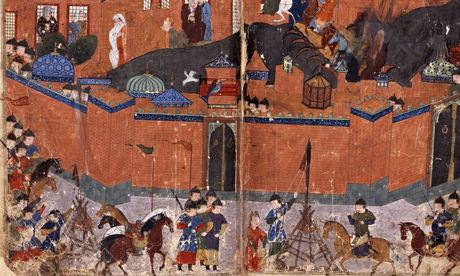
Mongols at the gates of Baghdad in 1258 … from the Jami al-Tawarikh by Rashid al-Din, c 1310.A slightly longer timescale for Iraqi cities is provided in "Baghdad by Justin Marozzi – review," by Christopher de Bellaigue, The Guardian, 11 June 2014, which reviews a new book beginning when "the city was founded by the Abbasid caliph Mansur in 762," and including (left) when the Mongols were at the gates in 1258.

Tuesday, June 10, 2014

Contextualizing Arab Spring - Now


"Confronting Amnesia and Political Change in the Arab World," by Martin Evans, History Today, Blog, 10 June 2014, highlights a new movie, They Are the Dogs, which appears to be about a worker released from prison for something that did or did not happen in the 1980s right at the time that Morocco is spiraling into crisis. (The article includes a trailer in English.) Morocco didn't have a "Spring," but the atmosphere on the streets is similar to that in Egypt or Tunisia.


  • "The film follows three members of a television crew as they set off to report on the protest movements in Morocco in February 2011. Intrigued by the strange mannerisms of an old man called Majhoul, the crew decide to focus their report on him. As they follow him through the backstreets of urban Casablanca, the crew discover the story of a man who has just been released from prison 30 years after a police raid during Morocco's 1981 food riots, and who is completely lost in a modern Morocco in the midst of the Arab Spring."
The UK premier of the film is at a conference on 16 June. Wish I could be there.

Wednesday, June 04, 2014

Iran: Another Year, another Spring

"Tehran Postcard: What Has Rouhani Changed In One Year?," by Claudio Gallo, Worldcrunch, 3 June 2014 (originally La Stampa, 27 May 2014) 
  • "'The atmosphere here has gotten better,' says Nima. 'The morality police aren’t harassing us so much anymore, and the tourists have come back. But we’re from Isfahan, in the center of the country, and everything there is still closed.'"

Friday, May 09, 2014

"What do we have to do with a revolution?"

Egypt's Tourism Crash Gives Way To Bustling Opium Trade - http://www.worldcrunch.com/culture-society/egypt-039-s-tourism-crash-gives-way-to-bustling-opium-trade/opium-farming-tourism-egyptian-revolution/c3s15827/?utm_medium=referral&utm_source=pulsenews#.U2zLn8oo7qA

Monday, April 28, 2014

Farouk or Nasser?


Richard Cavendish remembers Abdul Fattah al-Sisi's King Farouk's succession to the Egyptian throne on April 28th, 1936 (History Today 61, April 2011). Or were the army officers on the other side, at least by 1952? ("Egypt wonders if army chief General Sisi is another Nasser," Martin Chulov, Guardian News Service, Cairo, August 09, 2013)

Tuesday, April 15, 2014

Varieties of Revolution

"What is the Egyptian anti-coup movement protesting for?," by Neil Ketchley and Michael Biggs, Washington Post (April 4, 2014) analyzes polling data from protestors. Meanwhile, the protests, the mass trials (and incarcerations) continue.

Springs Eternal?

Barakat (Enough) anti-vote Algerians
"Eight Hopeful Legacies of the Arab Spring," by John Cassidy, The New Yorker, 14 April 2014. Meanwhile, signs of another Spring in Algeria?

Monday, September 09, 2013

Conspiracy Theories in the Middle East and the Midwest

One article in the New York Times and a related blogpost (admittedly by the same author) note how both Al Ahram in Egypt and Fox News in the USA appear to share the idea that the Obama presidency conspired with the Muslim Brotherhood, a plan "which involved helping 300 armed fighters enter the country from Gaza." (“Conspiring Against the Truth,” The Arabist, Ursula Lindsey, ) Likewise, another blogpost, notes four related misconceptions widely shared in Egypt:
  1. There is a strong held belief in Egypt that the US is against the June 30th alliance and government, and is waging war against it for the sake of MB....
  2. There really isn’t a global conspiracy against us....That being said, Turkey and Qatar are truly against us..., so you are not being completely paranoid here.... 
  3. The perception that international opinion provides excessive support for the MB, which develops at times to the belief that the international media is in the MB’s pockets....
  4. [The idea that this is a war on terror.] What is your counter idea to Islamism/MB ideology? Whoever does not agree with you is a traitor and should be killed? ("4 common Misconceptions Egyptians have," August 18, 2013, The Sandmonkey)
From the latter post, the key point for me is: "in order for the international media to showcase your side of the story, you actually have to have a side of the story." That is, the MB = terrorists doesn't hold water. They might have allied with those that did harbor terrorists or even were so. And they might be violent now. But the numbers dead before 30 June pale before those afterwards.

But if the explanatory power of the story coming out of Cairo is weak, that coming from The Washington Post is equally so.  Note only is this chart missing a number of obvious links, it suggests that any time one is not sending tanks or bullets, one doesn't have a clue.
(Max Fisher, “The Middle East, Explained in One (sort of Terrifying) Chart,” Washington Post, August 26, 2013). Of course, if we are discussing "no clue" in terms of the American public and not the American government, we are on somewhat safer ground: half of ["the American public"] could not find Syria on a map, as surveyed by the Pew Research Centre." ("These 'Syria for idiots' pieces are getting a bit much: Where will it end?," Oliver Williams, New Statesman, 04 September 2013)

Mapping the Middle East

While the surveys included in the set “40 Maps That Explain the World” (Max Fisher, August 12 2013, Washington Post) have not been delivered to many of the countries in the Middle East, the comparative information is useful for future research design. For example, has Egypt's belief in democracy over a strong leader changed in the last month?
More local mapping can be found of the protests and backlash in Egypt in August ("Mapping Egypt’s Week of Chaos," Joshua Keating, Slate, Aug. 20, 2013) Using some of the same technology as "Mapped: Every Protest on the Planet Since 1979," J. DANA STUSTER, Foreign Policy, AUGUST 22, 2013, the dark circles of Cairo are noteworthy, but it is probably those outliers where these will continue longest.

Sunday, July 08, 2012

Ci Devant Encore: Revolutionary Language for Remnants

First off, a thanks and a tip of the hat to Juan Cole. I have been reading a lot of Chicken Little reportage regarding Libya. The Libyans couldn't handle the truth, or freedom, or some such. It would balkanize into pre-1934 regions (not that I necessarily think that a bad thing, with my moniker and all). But I never heard that from Mr. Cole. No pie-in-the-sky, but his recent reports since the fall of the old regime have been consistently convincing, suggesting that one could walk the streets, do business, etc. ("Despite Airport Incident, Henry Kissinger is Wrong about Libya," by Juan Cole, Informed Comment, 6/05/2012). To be fair Zintan doesn't trust Tripoli and wants to keep their guns.  But I live in the Midwest, so what is new? Well, the reports so far suggest that these recent elections have been relatively peaceful. Relative to whom? Well a lot of places. Jamaica in the 1970s and 1980s comes to mind.

In any case, I return to my interest in the Ci devants, the remnants, the feloul, of the old regime after a revolution. Since everyone did something to survive under the old regime, all revolutions could use a little Truth and Reconciliation. What did you do in the Resistance, Daddy? That was a difficult question in France in the late 1940s and early 1950s.  So, via Cole's Informed Comment we learn the following:
  • In Libya, the remnants of the old regime are called ‘seaweed’ or ‘algae’ (tahallub), i.e. the flotsam left behind when the tide recedes. As in Tunisia and Egypt, there has been a lot of debate around what to do with them. They often have a lot of money, and are regrouping to succeed in the new system. Since a lot of prominent Libyan technocrats had been lured back to the country in the past decade..., leaders like Mahmoud Jibril (al-Warfalli) are considered by some to be leftovers, while others see him as someone who went over to the revolution and served as its first transitional prime minister. ("Top Ten Surprises on Libya’s Election Day," by Juan Cole, Informed Comment, 7/08/2012)
So now we have Ci devants, feloul, and tahallub. As the films of Senegalese director Ousmane Sembène - Xala, Mandabi - showed us, the new boss can look decidedly like the old boss post-colonial or post-revolution. But the Kampuchean Revolution shows what a "pure" changeover looks like with no use of the technocrats, etc. from the old regime. In Libya, as in Egypt it is a question of using those without too much of Les Mains Sales, not to say blood on their hands.

Sunday, June 17, 2012

Read Any Good Revolutions Lately?

[In the run-up to the run-off, I had been reviewing the past year's events in print and online. But, as I wrote the following, the Egyptian judges overturned the parliamentary elections (well some of them). What follows is not my comment on the current situation (counter-revolution?, coup?, just the messiness of transitioning from revolution to democracy?).  That will come later, if it is not beyond my abilities.]

manifestoAs protests begin to achieve a critical mass again (albeit much lower than last year) in Tahrir ("Tahrir Protests Continue," June 6, 2012, by Hossam El-Hamalawy, Jadaliyya), I have returned to a few books written after the first flush of enthusiasm about the Egyptian Spring (there is a movie Tahrir - Liberation Square, which looks interesting, but I have only seen the trailers). Three books focusing on events of 2011.  For an outsider, not simply trying to understand what happened/is happening in Egypt, but how to understand the modern world, I found Ashraf Khalil, Liberation Square: Inside the Egyptian Revolution and the Rebirth of a Nation (St. Martin’s Press, 2012) to be most revelatory. Wael Ghonim, Revolution 2.0 (2012) is mainly the story of the politicization of one person (albeit a very interesting and thought-provoking story).  Marwan Bishara, The Invisible Arab (2012) wants to jump straight to the commentary without enough grounding in the narrative (Bishara might have the grounding, but he doesn't provide the reader with it). Khalil, as a Cairo-based reporter for European news services, is both in the revolution and reporting on it. Intriguing chapters on Tahrir days reveal how the street protests actually created community (communities) more once the government shut down phone/internet communication, forcing everyone to speak to everyone else to find out what was going on on the next block. More than Ghonim and Bishara, Khalil roots the revolution in the past decade of Egyptian history.  As such, it appeals most to the mere historian in me.  See also, now a new collection of essays on this context ("The Journey to Tahrir: Revolution, Protest, and Social Change in Egypt," reviewed by Arang Keshavarzian, in mobilizingideas, June 13, 2012), which I suppose is my next port of call to read.

Finally, a very detailed reconstruction of the life and death of Khaled Saeed has been written by Amro Ali in Jadaliyya ("Saeeds of Revolution: De-Mythologizing Khaled Saeed," June 5, 2012 by Amro Ali, Jadaliyya)

Monday, May 28, 2012

Neither Feloul nor Islamist


Revolutions create their own sense of time and periodization. An article exploring why Hamdeen Sabbahi gained such support with a minimal machine behind him ("Why Did Sabbahi - 'One of Us' - Do So Well?," Jadaliyya [and Ahram Online], May 26 2012, by Ekram Ibrahim), notes that one of his chief attributes was that he was "neither feloul [remnant]...nor Islamist. Another is titled, "In the field of feloul, Shafiq rules" (by Rana Khazbak and Heba Afify, Egypt Independent, 26/05/2012). Another blog groups the votes of Shafiq and Moussa together to map the Feloul votes (which might surprise those leftists who were strategically voting with the latter only to see his candidacy slide into fourth ("Mapping the Egyptian Presidential Election," May 26, 2012, by Eric Schewe). But returning to Sabbahi; he is neither feloul nor Islamist because he is neither the candidate of a return to the Mubarak era (Ahmed Shafiq, currently in 2nd place) nor the Muslim Brotherhood's candidate (Mohamed Mursi, currently in 1st, although official results are not released). But Sabbahi is a self-described Nasserist, obviously a position of an old, very old regime, if not the old regime. In an election in which the 57-year-old Sabbahi can lay claim to the youth vote because he is the youngest candidate, everyone will be tied to the way pre-revolutionary politics were played in one way or another. The key is what politics they stand for going forward.

When French Revolutionaries created the Ancien Régime, post facto as that what they had been rebelling against, they created opponents of the Revolution which they called the Ci-devants (the "so-called").  The ci-devants were so-called because they were former aristocrats, whose privileges and social status were abolished by the Revolution (and the night of 4 August 1789). So there were no more nobles, but the remnant remained, at least in terms of those supporting the policies similar to or even the restoration of the Old Regime.

Which brings us to the Ancien Régime, the Old Order: "isqat al-nizam," was the cry to bring down the old "regime" in Egypt. But it was, by the vagaries of language, also the call to bring down "order." It is not surprising that many voters would seek to avoid demolishing order. The feloul voters, the ci-devants, are not simply those who benefited by the Old Order, but those who fear the absence of nizam.

Thursday, May 24, 2012

Egypt: Vox Pop, Vox Populi

(based on al-Ahram polls; see "Reading
the tea-leaves
" for the latest)
Yesterday, I posted a shout-out to Egypt on elections (that is, they often look uninspiring until one looks at the alternatives), and hoped they would soon have their own Nate Silver. Well, I found one. Issandr El Amrani today posts a useful analysis of the Egyptian Presidential Candidates and their prospects (based, of course on pre-election polling and positioning). ("My belated take on Egypt's elections," by Issandr El Amrani, The Arabist, May 24, 2012) If Aboul Fotouh or Sabahi would fit the view of those seeking change, that seems unlikely to be the desire of more than a third of the population.

Many posts, at least in English, are similar to vox pop journalism now running on Al Jazeera, etc. (see, for example, "Egypt Votes, At Last," by Wendell Steavenson, New Yorker, May 23, 2012). My own take from one such clip were women in line who stated (through the translation) that whoever won should take care, else they would vote him out next time. The revolution is not synonymous withe the elections. Day 2 of Egypt's first post-Mubarak presidential elections continues today.

Wednesday, May 23, 2012

Egypt: Vox Dei, Vox Populi?

Greetings, Egyptians. Welcome to the problems and opportunities of mass democracy. The process sometimes produces the debacle of hanging chads and the hung election between Al Gore and George W. Bush; and it sometimes produces the government of Il Popolo della Libertà party led by Silvio Berlusconi. But its value and veracity is never just in one election. May you long have the joy of psephology and may you soon have your own Nate Silver.

Friday, May 18, 2012

Assad and the Schmürz

Growing up in the Seventies became a search for the offbeat, the quirky (which might explain how I can put Lene Lovich, the Mael brothers, and Tristan Tzara in the same parenthetical comment). If the strange had already entered my school days with the plays of  Friedrich Dürrenmatt and Wolfgang Borchert, outside the school walls my friends and I entertained ourselves with the likes of Boris Vian. 

The dark, comic play, The Empire Builders by Boris Vian (Les Bâtisseurs d'Empire ou le Schmürz, 1957, pub. 1959), was described by LA Weekly (commenting on one of its periodic revivals) in this way:
  • "A respectable family of father, mother, daughter, and their maid, flee within the confines of their home, from a strange, unknown and terrifying Noise which pursues them as they move upward from floor to floor until they reach the attic. In each room, they find the same creature awaiting them: a dark, bandage-wrapped thing who suffers in silence as the family casually beats, whips, and pummels him." (City Garage Theater, n.d.)
Le Schmürz followed the family from room to smaller room to garret, quietly suffering beatings and various tortures, until the remnant of the family ends the play by self-defenestration, and an army of silent, bandage-wrapped personages appear. As a teenager, I presumably incompletely assumed that (1) Europeans had a lot of unresolved issues after 1945, and (2) Vian was not enamored of the bourgeois family.

Aleppo University, Thurs., 17 May 2012
But today's report that "thousands of people have taken to the streets in the northern Syrian city of Aleppo," suggest a similar shrinking scenario for Pres. Bashar al-Assad's regime.
  • Syria's second city has so far not experienced the violence seen in other cities during the uprising and has remained largely loyal to the government...since protests began in March 2011. ( "'Thousands' protest in northern Syrian city of Aleppo," 18 May 2012, BBC)
All is well; Damascus is largely loyal, said the bourgeois father from his attic room.

Tuesday, May 15, 2012

Friending Revolution


Reading two books which grew out of Arab Spring:
  • Wael Ghonim, Revolution 2.0: The Power of the People Is Greater Than the People in Power: A Memoir (Houghton Mifflin Harcourt, 2012) and 
  • Marwan Bishara, The Invisible Arab: The Promise and Peril of the Arab Revolutions (Nation Books, 2012).
(Amazon has a nice, simple interview with Mr. Ghonim.) Both works appear to be by writers who don't read books a lot. (This might apply more to Ghonim than to Bishara, but the notes from the latter cite mainly websites.) This is an observation, not a criticism. Ghonim's work is as much about social media and the synergy between education in marketing and computing and political science as it is about the Egyptian Revolution. Still, the first-person story makes the swirl of events (see this blog over the past year-plus) accessible; and provides key insights to generational shifts. And hope.