Showing posts with label Syria. Show all posts

Thursday, June 12, 2014

Mosul & the Lessons of History: Perhaps


MapMosul seized by a small group proclaiming a Sunni pan-state across Syria and Iraq. And now Kurds claiming back Kirkuk from the Arabisation that Saddam Hussein instituted on that northern Iraqi city ("Iraqi Kurds 'fully control Kirkuk' as army flees," by Paul Wood, BBC News, 12 June 2014).   "The Fall of Mosul and the False Promises of Modern History," by Juan Cole, History News Network, 11 June 2014, lays blame for recent events on, well, just about everyone.  "Hold Your Horses, Iraq Is Not About to Fall … Yet," by Douglas Ollivant, Foreign Policy, June 12, 2014, is not unwilling to apportion blame for the "known-unknowns." But what has happened is not yet clear, so perhaps assigning the lessons of why it happened might be a bit premature.

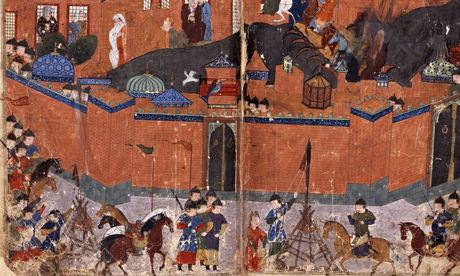
Mongols at the gates of Baghdad in 1258 … from the Jami al-Tawarikh by Rashid al-Din, c 1310.A slightly longer timescale for Iraqi cities is provided in "Baghdad by Justin Marozzi – review," by Christopher de Bellaigue, The Guardian, 11 June 2014, which reviews a new book beginning when "the city was founded by the Abbasid caliph Mansur in 762," and including (left) when the Mongols were at the gates in 1258.

Friday, May 18, 2012

Assad and the Schmürz

Growing up in the Seventies became a search for the offbeat, the quirky (which might explain how I can put Lene Lovich, the Mael brothers, and Tristan Tzara in the same parenthetical comment). If the strange had already entered my school days with the plays of  Friedrich Dürrenmatt and Wolfgang Borchert, outside the school walls my friends and I entertained ourselves with the likes of Boris Vian. 

The dark, comic play, The Empire Builders by Boris Vian (Les Bâtisseurs d'Empire ou le Schmürz, 1957, pub. 1959), was described by LA Weekly (commenting on one of its periodic revivals) in this way:
  • "A respectable family of father, mother, daughter, and their maid, flee within the confines of their home, from a strange, unknown and terrifying Noise which pursues them as they move upward from floor to floor until they reach the attic. In each room, they find the same creature awaiting them: a dark, bandage-wrapped thing who suffers in silence as the family casually beats, whips, and pummels him." (City Garage Theater, n.d.)
Le Schmürz followed the family from room to smaller room to garret, quietly suffering beatings and various tortures, until the remnant of the family ends the play by self-defenestration, and an army of silent, bandage-wrapped personages appear. As a teenager, I presumably incompletely assumed that (1) Europeans had a lot of unresolved issues after 1945, and (2) Vian was not enamored of the bourgeois family.

Aleppo University, Thurs., 17 May 2012
But today's report that "thousands of people have taken to the streets in the northern Syrian city of Aleppo," suggest a similar shrinking scenario for Pres. Bashar al-Assad's regime.
  • Syria's second city has so far not experienced the violence seen in other cities during the uprising and has remained largely loyal to the government...since protests began in March 2011. ( "'Thousands' protest in northern Syrian city of Aleppo," 18 May 2012, BBC)
All is well; Damascus is largely loyal, said the bourgeois father from his attic room.

Saturday, April 28, 2012

The Balkanization Of The Middle East?

I borrow Andrew Sullivan's article heading, which points to the lack of any deep historical identity for any country between Egypt and Iran.  Sullivan quotes Shlomo Avineri who notes:
  • "Most international borders in the Middle East and North Africa were drawn by imperial powers – Britain, France, and Italy – either after World War I and the breakup of the Ottoman Empire (the Sykes-Picot agreements), or, as in Libya and Sudan, earlier. But in no case did these borders correspond with local popular will, or with ethnic or historical boundaries. ("The Balkanization Of The Middle East," Andrew Sullivan, Daily Dish, 27 April 2012)
The latest focus is on the future of a Sunnis-Alawite-Druze-Christian-Kurd Syria. But one could also go back to the subject of the fascinating if a tad over-written and self-referential Churchill's Folly: How Winston Churchill Created Modern Iraq, by Christopher Catherwood (Basic Books, 2004).  [And there is always Michael Zwerin's text from the 70s (see image until I can post a photo of the cover of my personal copy, from which our moniker is derived.]

Saturday, April 21, 2012

Balkanization is Back: Did I Miss Anything?

Annan's six-point peace plan
Homs, Syria
  1. Syrian-led political process to address the aspirations and concerns of the Syrian people 
  2. UN-supervised cessation of armed violence in all its forms by all parties to protect civilians 
  3. All parties to ensure provision of humanitarian assistance to all areas affected by the fighting, and implement a daily two-hour humanitarian pause 
  4. Authorities to intensify the pace and scale of release of arbitrarily detained persons 
  5. Authorities to ensure freedom of movement throughout the country for journalists 
  6. Authorities to respect freedom of association and the right to demonstrate peacefully (21 April 2012, "UN votes to boost Syria mission," BBC)
Agreed  (however unlikely this is to be in practice: 17 April 2012, "Syria troops bombard Homs and other rebel areas," BBC). And this should be applied to: Syria, Bahrain, Iran, Iraq, Afghanistan, Texas.  Where else?

Wednesday, August 17, 2011

Crowdsourcing Fasfous and Mukhabarat

Notes on the Secret Police (mukhabarat) and Informants (fasfous) inside and outside Syria, even from form Mukhabarat themselves:
  • Among [those fleeing from Syria to Turkey] last week was a 25-year-old officer with the Mukhabarat secret police, who described how officers were increasingly unhappy at being ordered to kill unarmed protesters.
  • "They were all feeling like me. They were all afraid like me but knew they would be killed if they left or if they refused orders," he said.
  • Instead they tried to aim their shots in the air.
  • He also described bringing protesters – some as young as 13 – into police stations where they were beaten for the entertainment of senior officers. ("Iran snipers in Syria as part of crackdown," Rob Crilly, from Yayladagi, near the Turkish-Syrian border, 15 Aug 2011, The Telegraph)
This particular former Mukhabarat had not revealed his identity to fellow camp dwellers.  But Syrians are starting to make lists of those still working inside Syria.
  • In communities across Syria, activists are circulating lists of local government informers....
  • Activists insist that the purpose of publishing the lists...is to pressure and isolate those who inform on their neighbours rather than to initiate vigilante justice....
  • The regime in Syria has always relied on a network of paid informants – often known as fasfous – to keep the population under control....
  • According to one protester from the central Damascus neighbourhood of Midan, being associated with the secret police, or mukhabarat, offered protection, status and a source of income before the protests began. ("Syrian activists name regime informers,", by Abigail Fielding-Smith in Beirut, Financial Times July 28, 2011)
Of course, the terms themselves are of shifting meaning and import (neither official police, nor secret). At least they tend to dress the part, as if in a "B" movie.
  • Mind you that English phrase—”secret police”—is doubly misleading when applied to Syria’s cops.... [T]he “Mukhabarat,” [is] a catch-all term uttered only in hushed tones, which encompasses a multitude of agencies with responsibilities like “political security” or “internal security.” In Bashar Assad’s Syria, the Mukhabarat are nothing less than a professional bureaucracy specializing in the production and dissemination of fear....
  • The Mukhabarat’s agents are everywhere, inescapable in their unofficial uniform of black leather jackets and dress pants.  That they are easily recognizable points to the second misleading aspect of describing them as “secret police”: Much of the power of the Mukhabarat lies not in its secrecy, but in its visibility. Its personnel mingle with pedestrians on crowded streets, sit in cafes, or just stand on street corners, watching. ("Life Among Syria’s Not-So-Secret Police," by Jonathan Panter, Jasine Report, 14 July 2011)

Wednesday, August 03, 2011

The Whole World Is/Will Be/Should Be/Can Be Watching

Interesting story on Local Coordination Committees in Syria on Morning Edition, NPR.  Links to left include now Local Coordination Committees of Syria, and the LCC are now one of the main conduits of news out of that country.

Wednesday, May 04, 2011

Outsiders View Asad's Syria Inside

Joshua Landis provides a link to this video made by two Hungarian journalists, Gergő Plankó & Bence Gáspár Tamás, who shot great footage inside Damascus. (“Nobody Is Free In The World” – Report From Damascus by Gergő Plankó & Bence Gáspár Tamás, May 4th, 2011, English subtitles) It begins with a regional overview of protests, or, rather, crackdowns, then moves to original footage.

Sunday, March 20, 2011

Meanwhile: Syria, Yemen, Bahrain

Syria.  Protests here are more at the stage of Iran than Yemen (or perhaps I should state that the government is more in control like that in Tehran); but they are obviously significant.
  • "Protests expectedly started after the Friday prayers in the country and honestly knowing the fist of the regime there, I am surprised by the [extent of] public reaction and also participation....
  • "There were protests in Damascus, Aleppo, Daraa, Baniyas, Homs, and Deir El Zor....
  • "Of course you can imagine the panic of the regime there, the live ammunition was used directly." (March 19, 2011, "The Friday of Dignity in Syria: The start of revolution," Egyptian Chronicles, by Zeinobia)
(Hamad Mohammed/Reuters, 18 March)
(Joseph Eid/Getty Images, 16 March)
Bahrain.  Here I might mention a story from the Vendee, a protest against the French Revolution in the bocage region in the 1790s.  The Vendeeans refused to go to their local churches after priests that refused the oath of the Civil Constitution of the Clergy were replaced.  Instead, many started meeting outside in front of a large tree in which, it was believed, an image of the Virgin Mary had appeared.  The Vendeeans began meeting in front of the tree at night.  And then they began meeting armed in front of the tree.  Finally, the government supporters (the Jacobins supporting the French Revolution) cut down the tree.  This always struck me as odd, as the Government/Jacobins did not believe in miraculous images of the Virgin Mary.  In any case, the point of comparison is that tearing down the tree did not end the protests, which went on to become a major armed rebellion (Charles Tilly, The Vendee: A Sociological Analysis of the Counter-Revolution of 1793, Harvard University Press, 1976). Anyway, back to Bahrain:
  • Authorities in Bahrain have torn down the statue at the centre of Pearl roundabout in the capital, Manama, where pro-democracy protests were held for weeks....
  • Al Jazeera's special correspondent reports on the anger sparked off by deaths in the recent violence....
  • On Friday Sheikh Khaled bin Ahmed al-Khalifa, Bahrain's foreign minister, said the demolition of the statue was an effort to erase "bad memories". The statue that was demolished comprised six sails symbolising each of the six members of the Gulf Cooperation Council, holding up a pearl, symbol of the pearl fishing heritage that was the economic mainstay of the region before the discovery of oil.
  • "It is a kind of psychological victory for the protesters," said Hussein Oraibi, who works in telecommunications....
  • Al Jazeera's correspondent in Bahrain, speaking anonymously for safety reasons, said the monument "was the centre of the protests for a month; it was seen as being symbolic of anti-government sentiment.  It seems rather strange that by removing it there is the thought that that symbolism will disappear ... [The destruction] is very symbolic of that final stage in the last couple of days of this huge great crackdown on the opposition." ("Bahrain tears down protest symbol: Government demolishes statue in the centre of Manama where anti-government movement has gathered," Aljazeera, 18 Mar 2011)