- McCain keeps boasting about being "right" about the "surge" and saying Obama was "wrong."
- Look, it is more important that McCain was consistently wrong. He was wrong about the desirability of going to war against Iraq. He was wrong about it being a cakewalk. He was wrong about there being WMD there. He was wrong about everything. And he was wrong about the troop escalation making things better. The casualty figures dropped in al-Anbar, where few extra US troops were ever sent. They dropped in Basra, from which the British withdrew. Something happened. Putting it all on 30,000 extra troops seems a stretch. And what about all the ethnic cleansing and displacing of persons that took place under the nose of the "surge?" McCain has been wrong about everything to do with Iraq. And he is boasting about his wisdom on it! (Juan Cole, Informed Commment, July 22, 2008, "Troop Agreement Misses Deadline; Provincial Law Misses Deadline; Bombings in Mosul, Diyala, Fallujah")
Tuesday, July 22, 2008
more problematic than his belief that Iraq and Pakiston share a common border


Sunday, July 20, 2008
bombing is never a shortcut to winning hearts and minds

At least 13 Afghan police and civilians have died in two incidents involving international forces, officials say.
International forces have been involved in a series of controversies of controversies
Four Afghan police and five civilians died in an apparently mistaken air strike by international coalition forces in Farah province.
Separately, the Nato-led Isaf said it had "accidentally" killed at least four civilians in Paktika province. (BBC, 20 July 2008, "Coalition 'bombs Afghan police'")
Saturday, July 12, 2008
why wasn't this on the tv news; in the newspapers, etc?

People carry photos of the anti-American cleric Muqtada al-Sadr during a protest in Baghdad's Shiite stronghold of Sadr City, Iraq, Friday, July 11, 2008. (AP Photo/Karim Kadim)
BAGHDAD (AP) — Hundreds of followers of a radical Shiite cleric in Iraq have taken to the streets to protest a proposed security agreement between Iraq and the United States.
The supporters of cleric Muqtada al-Sadr say the proposed deal would lead to a permanent U.S. occupation of Iraq.
They held their protest Friday in the southern city of Kufa and shouted slogans such as: "No to America."
Such demonstrations have become a weekly event, usually following prayers held in local mosques on Fridays. (AP, "Some Iraqis protest security deal with US," 11 July 2008)
Monday, July 07, 2008
Things are better; can we go now?
 It is the PM's first public suggestion of a deadline for US withdrawal from Iraq |
Iraqi Prime Minister Nouri Maliki has raised the prospect of setting a timetable for the withdrawal of American troops from Iraq.
Talks are continuing on a new security deal, but the US has said it opposes setting any timetable for withdrawal.
The UN mandate under which US troops stay in Iraq expires at the end 2008.
Correspondents say Mr Maliki may have an easier time getting the support of Iraqi MPs by proposing a deal which includes a withdrawal timetable. (Monday, 7 July 2008 15:53 UK, BBC,"Iraq floats US pullout timetable")Sunday, July 06, 2008
the surge is...
...fill in the blank.
Here is the point: the surge of a 21st army against pipe-bomb insurgents will always "work," in the short run. An invading/conquering army has control of the air, the main arteries, and backup. Insurgents have..., well, time. Until the sides talk and recognize each other's strengths, then the situation that produced the insurgency--lack of jobs, ethnic cleansing, etc.--continues. Of course, the Maliki government will announce the success of the current program, because their continued "success" depends on American, well, continuance. Yet:
...fill in the blank.
Here is the point: the surge of a 21st army against pipe-bomb insurgents will always "work," in the short run. An invading/conquering army has control of the air, the main arteries, and backup. Insurgents have..., well, time. Until the sides talk and recognize each other's strengths, then the situation that produced the insurgency--lack of jobs, ethnic cleansing, etc.--continues. Of course, the Maliki government will announce the success of the current program, because their continued "success" depends on American, well, continuance. Yet:
- The insurgency is mainly against American targets, and our allies. Don't we expect at least some decline if those targets are no longer there?
- The main reason for the decline in violence has little to do with our troops, and everything to do with walls, surveillance, etc., which has resulted in a MORE balkanized Baghdad, and a more balkanized Iraq. Which means, of course, that what we claimed we are fighting for (well the fourth attempt to explain what we were fighting for; remember: Get rid of WMD's?--fake; stop Saddam Hussein from providing safe haven for Al Qaeda?--fake; bring democracy to the Middle East?--fake {and ludicrous}), that is, a stable, unified government is, get this, NEVER GOING TO HAPPEN. Three separate governments, yes; three governments unified in a very loose federation, possibly. But the only thing these folks are unified in, is, that US troops need to leave. Now.
- The longer we stay, the strong Iran is in the region.
'Weak institutions'
Millions in development money have notoriously gone to waste in the seven years since the fall of the Taleban, the BBC's Alastair Leithead reports from Kabul.
Afghan people on improving life
Many countries spend a chunk of their aid through the government or on a trust fund set aside to fund National Solidarity Programmes in more than 22,000 districts of the country.
Mr Eide believes more should be spent this way.
In Kabul on Sunday, he will outline to the government and donors that they have got to be more co-ordinated and to deliver development more effectively and efficiently.
"We also have to see how we can spend our money in a way that builds Afghan capacity," he said.
"We see how weak the institutions are - that we have to make sure we correct."
Corruption is a major issue and the words auditing and accountability will be buzzing around the room at the first monitoring board meeting since the Paris conference, our correspondent says.
The UN head in Afghanistan is trying to take control of an aid effort that many think has been missing the mark, when winning people over to the government, and keeping the Taleban at bay, is so vital for the future, he adds. (Sunday, 6 July 2008 07:27 UK, BBC, "UN to urge revamp of Afghan aid")
Monday, June 23, 2008
thought for the day
from "[Rick] Shenkman: Why the American People Were So Easily Bamboozled by the Bush Administration," in Informed Comment, by Juan Cole, Monday, June 23, 2008

from "[Rick] Shenkman: Why the American People Were So Easily Bamboozled by the Bush Administration," in Informed Comment, by Juan Cole, Monday, June 23, 2008
- As we head into the Fall campaign and listen to the debates about the war we should keep in mind the limits of public opinion. If we don't begin to address the problem of gross public ignorance there will be more Iraqs.
- One poll finding we should all keep in mind is this. Even after the 9/11 Commission reported that there was no connection between Saddam Hussein and the Sept. 11 attack 50 percent of the country persisted in believing there was. The implications of this are mind boggling.
Wednesday, June 18, 2008
as Queen Anne said after the latest battle victory and loss of life in the War of Spanish Succession....
...How many more victories can we take?
- Defence Secretary Des Browne said: "We've had a very difficult time over the last 10 days. We've lost nine soldiers altogether in three separate incidents."
- He added: "The Taleban are losing in Afghanistan, I know it may not appear like that at the moment, but we are enjoying a degree of success."
- The latest deaths are the biggest single loss of British lives in Afghanistan since an RAF Nimrod crash in 2006 which killed 14 servicemen.
- BBC News defence correspondent Caroline Wyatt said the feeling among British military leaders was that the Taleban were being outgunned and that their command-and-control was disintegrating.
- The problem is that this has driven the Taleban to measures such as the latest explosion which are very difficult to defend against, she said. (18 June 2008, BBC, "Woman soldier among Afghan dead")
Tuesday, June 17, 2008
and what kbr wants....
- The Army official who managed the Pentagon’s largest contract in Iraq says he was ousted from his job when he refused to approve paying more than $1 billion in questionable charges to KBR, the Houston-based company that has provided food, housing and other services to American troops.
- The official, Charles M. Smith, was the senior civilian overseeing the multibillion-dollar contract with KBR during the first two years of the war. Speaking out for the first time, Mr. Smith said that he was forced from his job in 2004 after informing KBR officials that the Army would impose escalating financial penalties if they failed to improve their chaotic Iraqi operations.]
- Army auditors had determined that KBR lacked credible data or records for more than $1 billion in spending, so Mr. Smith refused to sign off on the payments to the company. “They had a gigantic amount of costs they couldn’t justify,” he said in an interview. “Ultimately, the money that was going to KBR was money being taken away from the troops, and I wasn’t going to do that.”
- But he was suddenly replaced, he said, and his successors — after taking the unusual step of hiring an outside contractor to consider KBR’s claims — approved most of the payments he had tried to block.
- Army officials denied that Mr. Smith had been removed because of the dispute, but confirmed that they had reversed his decision, arguing that blocking the payments to KBR would have eroded basic services to troops. They said that KBR had warned that if it was not paid, it would reduce payments to subcontractors, which in turn would cut back on services. ("Army Overseer Tells of Ouster Over KBR Stir," The New York Times, by JAMES RISEN, June 17, 2008)
Saturday, June 14, 2008
meanwhile: not so clear sailing in Afghanistan
And as Juan Cole points out below, it is not at all clear that this was the Taliban instead of a more scary general insurgency.
And as Juan Cole points out below, it is not at all clear that this was the Taliban instead of a more scary general insurgency.
- Pushtun guerrillas mounting an insurgency against the Karzai government and against NATO troops in the Pushtun areas of Afghanistan staged a daring prison break on Friday. They set off bombs at a prison in Qandahar, killing 15 prison guards and allowing 1100 inmates to escape, including 400 captured guerrillas. Although the US refers to the guerrillas as 'Taliban' it is not clear that they are seminary students are actually linked to the Taliban movement of the 1990s. Many appear to be disgruntled Pushtun villagers.
- The jailbreak spoke eloquently of the weakness and incompetence of the Karzai government, which many observers believe is in the process of collapsing under the weight of its own corruption.
- The collapse seems to be accelerating even though the number of foreign troops in the country has grown enormously, to some 30,000 US and 30,000 NATO soldiers. Foreign donors recently pledged $20 bn in aid, though $10 bn of that came from the US and European donors seemed distinctly wary of having their money go into the pockets of the Afghan bureaucrats and those of their extended families.
- In May, more US and allied troops were killed by guerrillas in Afghanistan than in Iraq. (JUan Cole, Informed Comment, "Saturday, June 14, 2008, Massive Guerrilla attack in Afghanistan; 4 Marines Killed")
i need to see this...soon (please come my way)
From Sgt. Brent Sammann, an active-duty soldier in the US Army:
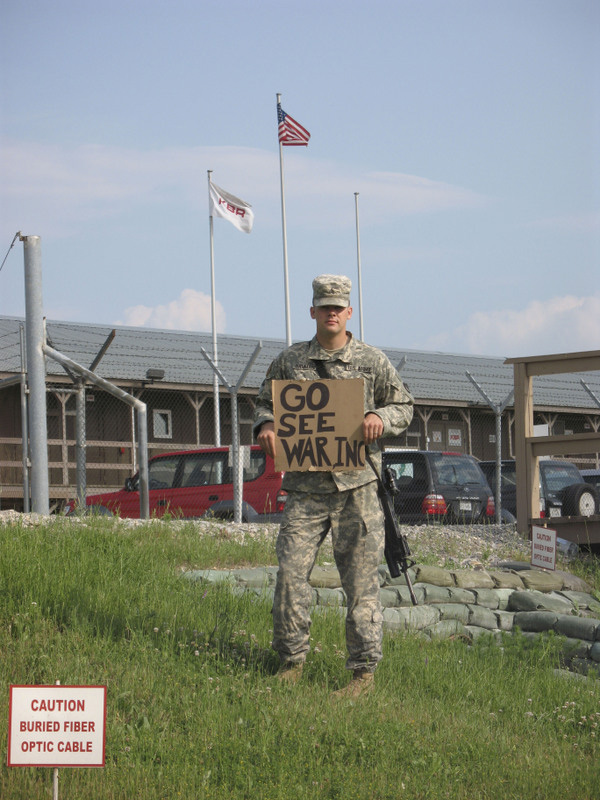 |
I'm a first-hand witness to the exploitation by KBR and other companies lending their services to the war effort -- services us soldiers are fully capable of doing ourselves.... The military is being overcharged by these companies on a regular basis. Also, the poor service and treatment we get from some of their employees who make three times as much as those of us serving our country that are not in it for the money but are trying to make the world a better place for everyone.
From SPC (P) Johnny Rhodes in 3/2 SCR Infantry based in Diyala, Iraq:
After being awake for 3 days I may be a little bit out of it, so excuse any rambling or incoherence on my part. Off the top of my head, I can easily say that KBR in particular is of no help here in my area of Iraq. They do, jobs soldiers could do, get paid way better for it, but the work is almost always substandard.... at any given time there are hordes of these guys tying up the phones and internet, cramming the chow hall, etc. Which makes the soldiers have to wait. And wait. And wait. They also paid way more than me, for a job, I could do with my eyes closed.
From Brenda Clampitt, of Baton Rouge, LA, the wife of a soldier stationed at Camp Adder in Tallil, Iraq:
[My husband] drives the trucks and Humvees and escorts the KBR around where they need to go. He doesn't understand why they get paid way more then he does when [he and his fellow soldiers] are the ones doing the protecting, and are the ones getting shot at and blown up. He has seen soldiers die in front of him; he has seen lives destroyed and the country torn apart. My husband would serve his country whether he got paid or not, that is just how he is. He loves his country and wants to protect it but he sees first hand what is going on over there and he doesn't like it.... I myself am sick and tired of this war. It is dragging on and on and it is all about the money. I am not anti war. But I am FOR everything your movie is about.
Today's lead editorial in the New York Times, titled "Interrogation for Profit," decries "one of the Bush administration's most blatant evasions of accountability in Iraq -- the outsourcing of war detainees' interrogation to mercenary private contractors" and calls on Congress to approve "measures to make war-zone contractors liable for criminal behavior." The editorial concludes: "The way out of the Iraq fiasco must include an end to the outsourced shadow armies."
This indictment has the same urgency of War Inc. Especially with John McCain reminding us that it's "not that important" to him when our troops come home. (from Arianna Huffington, "War, Inc: Cusack's Savage Satire Strikes a Chord with Soldiers and Their Families," June 12, 2008)
Tuesday, June 10, 2008
hookergate goes on and on
A BBC investigation estimates that around $23bn (£11.75bn) may have been lost, stolen or just not properly accounted for in Iraq.
- For the first time, the extent to which some private contractors have profited from the conflict and rebuilding has been researched by the BBC's Panorama using US and Iraqi government sources.
- A US gagging order is preventing discussion of the allegations.
- The order applies to 70 court cases against some of the top US companies.
War profiteering
- While George Bush remains in the White House, it is unlikely the gagging orders will be lifted.
- To date, no major US contractor faces trial for fraud or mismanagement in Iraq.
- The president's Democrat opponents are keeping up the pressure over war profiteering in Iraq.
- Henry Waxman who chairs the House Committee on Oversight and Government Reform said: "The money that's gone into waste, fraud and abuse under these contracts is just so outrageous, its egregious.
- "It may well turn out to be the largest war profiteering in history."
- In the run-up to the invasion one of the most senior officials in charge of procurement in the Pentagon objected to a contract potentially worth seven billion that was given to Halliburton, a Texan company, which used to be run by Dick Cheney before he became vice-president.
- Unusually only Halliburton got to bid - and won.
Missing billions
- The search for the missing billions also led the programme to a house in Acton in West London where Hazem Shalaan lived until he was appointed to the new Iraqi government as minister of defence in 2004.
 Judge Radhi al Radhi: "I believe these people are criminals." |
- He and his associates siphoned an estimated $1.2 billion out of the ministry.
- They bought old military equipment from Poland but claimed for top class weapons.
- Meanwhile they diverted money into their own accounts.
- Judge Radhi al-Radhi of Iraq's Commission for Public Integrity investigated.
- He said: "I believe these people are criminals.
- "They failed to rebuild the Ministry of Defence , and as a result the violence and the bloodshed went on and on - the murder of Iraqis and foreigners continues and they bear responsibility."
- Mr Shalaan was sentenced to two jail terms but he fled the country.
- He said he was innocent and that it was all a plot against him by pro-Iranian MPs in the government.
- There is an Interpol arrest out for him but he is on the run - using a private jet to move around the globe.
- He stills owns commercial properties in the Marble Arch area of London. ("BBC uncovers lost Iraq billions," By Jane Corbin," BBC News, 10 June 2008)
lest we forget....
Some specifics from Rockefeller's statement (emphasis [Arianna Huffington's):
- Statements and implications by the President and Secretary of State suggesting that Iraq and al-Qa'ida had a partnership, or that Iraq had provided al-Qa'ida with weapons training, were not substantiated by the intelligence.
- Statements by the President and the Vice President indicating that Saddam Hussein was prepared to give weapons of mass destruction to terrorist groups for attacks against the United States were contradicted by available intelligence information.
- Statements by President Bush and Vice President Cheney regarding the postwar situation in Iraq, in terms of the political, security, and economic, did not reflect the concerns and uncertainties expressed in the intelligence products.
- Statements by the President and Vice President prior to the October 2002 National Intelligence Estimate regarding Iraq's chemical weapons production capability and activities did not reflect the intelligence community's uncertainties as to whether such production was ongoing.
- The Secretary of Defense's statement that the Iraqi government operated underground WMD facilities that were not vulnerable to conventional airstrikes because they were underground and deeply buried was not substantiated by available intelligence information.
- The Intelligence Community did not confirm that Muhammad Atta met an Iraqi intelligence officer in Prague in 2001 as the Vice President repeatedly claimed.
So much for the tired claim that "everybody in the world" agreed that Iraq had WMD, was a "grave and gathering threat," was in league with Al Qaeda, etc., etc., etc. (Arianna Huffington, "The Big Story You May Have Missed During the Obama v. Clinton Finale," June 9, 2008)
Saturday, May 10, 2008
My response to May 09, 2008, "Obama Needs a History Lesson," By Jack Kelly, from RealClearPolitics
Sorry, Mr. Kelly, weak history on the part of the pundit on this one. Orwell made the point that one's enemies today are allies tomorrow in his 1984, written in 1948 -- get it? -- which is a date relevant to two of Sen. Obama's and your examples. Everyone concerned was aware that ally Russia/Joseph Stalin had been and could be an enemy. Still, as Churchill noted when asked why he a staunch anti-Communist would work with Stalin; he replied he would work with the devil himself, if he thought it could bring down Hitler faster. (Which means, of course, that your view, Mr. Kelly, also goes against Churchill's.)
The problem, of course, is that keeping to a hard-and-fast view of who the enemy is (dog-headed, enemy to mankind, eats babies, etc.) means living in a non-existent world. It means that we identify an enemy -- USSR invading Afghanistan for example -- and then support those resisting that enemy unreservedly -- weapons to the Taliban, etc., with little sense that roles can change. It turns out, in the real world, the enemy is not dog-headed, eating babies, etc. Diplomacy is as much a part of realpolitik as iron and blood.
Perhaps there is nothing all that new in what Sen. Obama said. But it makes a lot more sense that Mr. Kelly's Medieval mantras.
Posted by: balkanization
Date: 05/10/2008 03:17PM
Sorry, Mr. Kelly, weak history on the part of the pundit on this one. Orwell made the point that one's enemies today are allies tomorrow in his 1984, written in 1948 -- get it? -- which is a date relevant to two of Sen. Obama's and your examples. Everyone concerned was aware that ally Russia/Joseph Stalin had been and could be an enemy. Still, as Churchill noted when asked why he a staunch anti-Communist would work with Stalin; he replied he would work with the devil himself, if he thought it could bring down Hitler faster. (Which means, of course, that your view, Mr. Kelly, also goes against Churchill's.)
The problem, of course, is that keeping to a hard-and-fast view of who the enemy is (dog-headed, enemy to mankind, eats babies, etc.) means living in a non-existent world. It means that we identify an enemy -- USSR invading Afghanistan for example -- and then support those resisting that enemy unreservedly -- weapons to the Taliban, etc., with little sense that roles can change. It turns out, in the real world, the enemy is not dog-headed, eating babies, etc. Diplomacy is as much a part of realpolitik as iron and blood.
Perhaps there is nothing all that new in what Sen. Obama said. But it makes a lot more sense that Mr. Kelly's Medieval mantras.
Friday, May 09, 2008
obama leads in superdelegates according to abc
I made the following post on abc (for some reason I don't know how to spell gaugeing):
I made the following post on abc (for some reason I don't know how to spell gaugeing):
Superdelegates want what is best for the party; but their best way of gauging that is to look at the popular vote and the pledged delegate count. Sen. Obama leads in those two categories and, oh yes, he leads in amount of money raised by large numbers of people sending in small amounts. Superdelegates are not directing this parade; they are simply joining in.
So Sen. Obama and his organization have shown they have the moxie to win. Sen. McCain and his policies will certainly benefit the super-rich; but the idea that John and Cindy are less elitist than Barack and Michelle is laughable. The latter might have more education; but folks, that used to be a good thing.
Monday, May 05, 2008
I appended the following to a petition for an inquiry demanded by John Kerry (at least I tried to; his website doesn't appear to work too well_.
I am quite concerned about the growth of what Eisenhower warned about: the growth of the military-industrial complex. Particularly egregious are no-bid and cost-plus contracts going to a small group of semi-private firms. If these firms are then "planting" the military support of policies that benefit the bottom line of these firms, this is EXACTLY what Pres. Eisenhower warned against. Separation of Public and Private when one is discussing War is just as essential as separation of Church and State.
The original:
I am quite concerned about the growth of what Eisenhower warned about: the growth of the military-industrial complex. Particularly egregious are no-bid and cost-plus contracts going to a small group of semi-private firms. If these firms are then "planting" the military support of policies that benefit the bottom line of these firms, this is EXACTLY what Pres. Eisenhower warned against. Separation of Public and Private when one is discussing War is just as essential as separation of Church and State.
The original:
Help get an investigation of the Pentagon pundit program
Nearly two weeks ago, the New York Times reported on a covert Pentagon plan in, “an effort to transform the analysts into a kind of media Trojan horse — an instrument intended to shape terrorism coverage from inside the major TV and radio networks." The goal of this program: get coverage favorable to Bush Administration policies.
But since that story, there's been little effort to find out more about this program, and essentially zero coverage of the revelation on television news.
With a near total blackout on the story from the television news networks, we need the American people to demand answers!
Co-sign the letter John Kerry wrote to the GAO demanding an investigation and help us get answers.
Tuesday, January 29, 2008
"President Bush should be out here watching this ramp ceremony to see what it is really like," said one soldier, who asked not to be identified.
"The people who created this war need to be thinking about the families of these 18-year-olds who are dying."
it appears that the surge + arming sunni tribal militias = relative calm to one or two provinces. it does not appear if it can bring peace to the entire country. what about an expanded jobs program to rebuild the country, a pull-back to western anbar as usa interest are really in kuwait and saudi arabia, not iraq, and an acceptance of, well, balkanization? we already appear to have accepted ethnic cleansing in baghdad.
Thursday, December 13, 2007
reconstituting terrorist groups among our allies
Summer NIE estimate: "In some ways, the most startling assertion made was that al Qaeda has reconstituted itself in Pakistan. What is startling is that it appears to acknowledge that the primary U.S. mission in the war -- the destruction of al Qaeda -- not only has failed to achieve its goal, but also has done little more than force al Qaeda out of Afghanistan and into Pakistan." ("Week out of Focus: Washington, Iraq and Al Qaeda," By George Friedman, 17 July 2007, Geopolitical Intelligence Report, Stratfor)
Summer NIE estimate: "In some ways, the most startling assertion made was that al Qaeda has reconstituted itself in Pakistan. What is startling is that it appears to acknowledge that the primary U.S. mission in the war -- the destruction of al Qaeda -- not only has failed to achieve its goal, but also has done little more than force al Qaeda out of Afghanistan and into Pakistan." ("Week out of Focus: Washington, Iraq and Al Qaeda," By George Friedman, 17 July 2007, Geopolitical Intelligence Report, Stratfor)
diplomatic surge working: for now
U.S. Ambassador to Iraq Ryan Crocker met Aug. 6 with Iranian Ambassador to Iraq Hassan Kazemi Qomi and Iraqi National Security Adviser Muwaffaq al-Rubaie. Separately, a committee of Iranian, Iraqi and U.S. officials held its first meeting on Iraqi security, following up on an agreement reached at a July ambassadorial-level meeting. ("The Major Diplomatic and Strategic Evolution in Iraq," By George Friedman, 8 July 2007, Geopolitical Intelligence Report, Stratfor)
U.S. Ambassador to Iraq Ryan Crocker met Aug. 6 with Iranian Ambassador to Iraq Hassan Kazemi Qomi and Iraqi National Security Adviser Muwaffaq al-Rubaie. Separately, a committee of Iranian, Iraqi and U.S. officials held its first meeting on Iraqi security, following up on an agreement reached at a July ambassadorial-level meeting. ("The Major Diplomatic and Strategic Evolution in Iraq," By George Friedman, 8 July 2007, Geopolitical Intelligence Report, Stratfor)
Subscribe to:
Posts (Atom)