Sunday, April 29, 2007

how is it going (really)?
  • the ideal: Work is nearing completion on a project that will allow Baghdad International Airport (BIAP) to achieve 100 percent electrical self-sufficiency. ("Iraqi Infrastructure: Baghdad International Airport to achieve 100 percent electrical self-sufficiency," portaliraq, July 1st 2005)
  • the reality: At the airport, crucially important for the functioning of the country, inspectors found that while $11.8 million had been spent on new electrical generators, $8.6 million worth were no longer functioning. ("Rebuilt Iraq Projects Found Crumbling," By JAMES GLANZ, New York Times, April 29, 2007)
  • the ideal: Iraqi sub-contractors finish plastering the ceiling in a barracks room of the Iraqi Special Forces barracks compound outside of Baghdad, Iraq, on July 12, 2005. Each barracks will house approximately 120 men. (Photo, Jim Gordon, from '"Talking Proud," Service & Sacrifice,' by Ed Marek)
  • the reality: A case in point was the $5.2 million project undertaken by the United States Army Corps of Engineers to build the special forces barracks in Baghdad. The project was completed in September 2005, but by the time inspectors visited last month, there were numerous problems caused by faulty plumbing throughout the buildings, and four large electrical generators, each costing $50,000, were no longer operating. ("Rebuilt Iraq Projects Found Crumbling," By JAMES GLANZ, New York Times, April 29, 2007)
overall?:
  • In a troubling sign for the American-financed rebuilding program in Iraq, inspectors for a federal oversight agency have found that in a sampling of eight projects that the United States had declared successes, seven were no longer operating as designed because of plumbing and electrical failures, lack of proper maintenance, apparent looting and expensive equipment that lay idle. ("Rebuilt Iraq Projects Found Crumbling," By JAMES GLANZ, New York Times, April 29, 2007)

Saturday, April 28, 2007

no surrender date...

...we tend to think of it as a very long engagement.
  • The Bush administration will not try to assess whether the troop increase in Iraq is producing signs of political progress or greater security until September, and many of Mr. Bush’s top advisers now anticipate that any gains by then will be limited, according to senior administration officials. ("The White House Scales Back Talk of Iraq Progress," By DAVID E. SANGER, April 28, 2007, Washington Post)
in other words, don't be looking for victory claims by the u.s. government; but they still claim anyone that doesn't follow them down the rabbit hole is holding up a white flag. the answer continues to be political and diplomatic talks that the eschew. the time for war is quickly drawing to a close. ask the army:
  • After going into Iraq with too few troops and no coherent plan for postwar stabilization, America's general officer corps did not accurately portray the intensity of the insurgency to the American public. The Iraq Study Group concluded that "there is significant underreporting of the violence in Iraq." The ISG noted that "on one day in July 2006 there were 93 attacks or significant acts of violence reported. Yet a careful review of the reports for that single day brought to light 1,100 acts of violence. Good policy is difficult to make when information is systematically collected in a way that minimizes its discrepancy with policy goals." Population security is the most important measure of effectiveness in counterinsurgency. For more than three years, America's generals continued to insist that the U.S. was making progress in Iraq. However, for Iraqi civilians, each year from 2003 onward was more deadly than the one preceding it. For reasons that are not yet clear, America's general officer corps underestimated the strength of the enemy, overestimated the capabilities of Iraq's government and security forces and failed to provide Congress with an accurate assessment of security conditions in Iraq. Moreover, America's generals have not explained clearly the larger strategic risks of committing so large a portion of the nation's deployable land power to a single theater of operations. ("A failure in generalship,"
    By Lt. Col. Paul Yingling, Armed Forces Journal, May 2007)
first the ISG and now the officers. if the u.s. does not start planning the endgame now, this will be even more a disaster for the iraqi people than it now is (picture, car bomb, karbala, 28 april 2007, AP Photo/Ghassan al-Yasiri).

Wednesday, April 18, 2007

what if they gave a war on terror and no one came?

british have rejected the terminology of a "war on terror." and, in iraq, where there is definitely a war of some kind, it is becoming increasingly clear that no one wants to be left holding the bag.
  • Three retired generals approached about a proposed high-profile post overseeing the wars in Iraq and Afghanistan have turned it down, leaving the White House struggling to find anyone of stature willing to take it on.
  • One of the four-star generals said he declined because of the chaotic way the Iraq war was being run and because Dick Cheney, the vice-president and leading hawk in the Bush administration, retained more influence than pragmatists looking for a way out.
  • The deputy White House spokeswoman, Dana Perino, confirmed that George Bush was considering restructuring the administration to create the post, dubbed the war tsar by US media. It would involve co-ordinating the work of the defence, state and other departments and reporting directly to the president at what Ms Perino described as a critical stage in the wars. One retired officer who was approached, Marine General John Sheehan, told the Washington Post: "The very fundamental issue is they don't know where the hell they're going."
  • The unwillingness of the generals to take the job undermines attempts by the administration to put a positive spin on the war. Mr Bush says there are signs that his strategy of pouring extra troops into Baghdad and neighbouring Anbar province is working. ("Top US generals reject war tsar role," by Ewen MacAskill in Washington, Guardian Weekly, 22 April 2007)

Wednesday, April 11, 2007

small bit of good news?

well at least a hopeful suggestion for the future. small ax fave, juan cole (see informed comment) has a piece in the nation, April 9, 2007, April 23, 2007 issue, "How to Get Out of Iraq," by Juan Cole. recommended.

profiteering on this war..., and the next

i suppose to empasize that dick cheney was ceo 1995-2000 of these guns for hire and has defended them doing business in iran is somehow to make unfair aspersions.
  • Halliburton is moving to UAE at a time when it is being investigated in the U.S. for bribery, bid rigging, defrauding the military and illegally profiting in Iran. It is currently in the process of divesting all of its ownership interest in the scandal-plagued KBR subsidiary, notorious for overcharging the military and serving contaminated food and water to the troops in Iraq.
  • Although Halliburton will still be incorporated inside the United States, moving its corporate headquarters to UAE will make it easier to avoid accountability from federal investigators....
  • Halliburton has also used its operational structure for contracts in Iraq and post-Katrina -- especially multiple layers of subcontractors -- to elude oversight and accountability to taxpayers....
  • The United States has no extradition treaty with the UAE....
  • Sarah Anderson of the Institute for Policy Studies notes that most Fortune 500 companies have global operations, so that moving an entire headquarters to another country is not necessary. "With today's technologies, there's no real reason to have to physically relocate," she said....
  • Martin Sullivan, contributing editor at the nonpartisan Tax Notes magazine, said relocating to the no-tax jurisdiction of Dubai would change Halliburton's tax situation "significantly" even though the company would still be registered in the US. By re-locating its CEO and other top executives to Dubai, Halliburton can argue that a portion of its profits should be attributed to the no-tax jurisdiction, he said.
  • Halliburton earned a record $2.3 billion in profit last year. That's almost equal to the $2.7 billion the Pentagon found in the company's overcharges in Iraq. ("Halliburton bails out of Iraq, KBR and now America," 12 March 2007, Halliburton Watch)

Saturday, April 07, 2007


just a reminder that we never got to the bottom of hookergate
  • President Bush's special guest at Fort Irwin was California congressman Jerry Lewis. While not a veteran himself, Lewis is the ranking Republican on the House Appropriations Committee. And, more poignantly, he's the man federal prosecutor Carol Lam announced she wanted a search warrant for, the day before she was fired....
  • Lam had already convicted Randy "Duke" Cunningham. Her new investigation might have tied Lewis to the lobbying firms and contributors he and Cunningham shared, and three decades of pork and kickbacks from defense contractors, including one case that may or may not have involved a software contract for a Lewis crony to digitize the original plans of the Panama Canal. And, you know, the rent-free yacht and the Rolls and the prostitutes and all that. (Chris Kelly, 04.06.2007, "George Bush and Jerry Lewis in 'At War with the Army,'" Huffington Post
lewis, for those keeping score at home, has recently been the subject of an investigation stemming from indictments of cunningham and brent wilkes:
  • A separate federal criminal investigation of Rep. Jerry Lewis, the California Republican who until January 2006 was chairman of the House Appropriations Committee, is continuing in Los Angeles. Prosecutors in that case are looking at Mr. Lewis's relationship with Mr. Wilkes, which included campaign contributions from Mr. Wilkes and associates and the hiring by Mr. Wilkes of a lobbying firm founded by one of Mr. Lewis's closest friends, former Rep. Bill Lowery. ("WSJ: GOP Rep Should Be Sweatin' Indictments," By Paul Kiel, February 14, 2007, 11:26 AM, TPMuckraker, quoting The Wall Street Journal)

Monday, April 02, 2007

uk-iran-usa-iran-turkey-iran...

all eyes on iran's seizure of uk sailors. is there any link to the following two stories?
  • An Iranian general who went missing on a visit to Turkey last month appears to have defected to America, taking with him a treasure trove of his country’s most closely guarded secrets.
  • Ali Resa Asgari, 63, a general in the elite Revolutionary Guards and former Deputy Defence Minister, vanished on February 7 after arriving in Istanbul on a flight from Syria. He had reservations at the Ceylan Intercontinental Hotel but never checked in.
  • Iran has notified Interpol and raised fears that General Asgari might have been kidnapped. Yesterday, however, several sources confirmed reports in America that General Asgari had fled to the West, becoming the first senior Iran official to defect since the revolution 27 years ago. (The Times, March 9, 2007, "Elite Iranian general defects with Hezbollah’s arms secrets," Richard Beeston and Michael Theodoulou)
and this one (well, it obviously has connection with the following, but i wonder about the february story):
  • A failed American attempt to abduct two senior Iranian security officers on an official visit to northern Iraq was the starting pistol for a crisis that 10 weeks later led to Iranians seizing 15 British sailors and Marines.
  • Early on the morning of 11 January, helicopter-born US forces launched a surprise raid on a long-established Iranian liaison office in the city of Arbil in Iraqi Kurdistan. They captured five relatively junior Iranian officials whom the US accuses of being intelligence agents and still holds.
  • In reality the US attack had a far more ambitious objective, The Independent has learned. The aim of the raid, launched without informing the Kurdish authorities, was to seize two men at the very heart of the Iranian security establishment.
  • Better understanding of the seriousness of the US action in Arbil - and the angry Iranian response to it - should have led Downing Street and the Ministry of Defence to realise that Iran was likely to retaliate against American or British forces such as highly vulnerable Navy search parties in the Gulf. The two senior Iranian officers the US sought to capture were Mohammed Jafari, the powerful deputy head of the Iranian National Security Council, and General Minojahar Frouzanda, the chief of intelligence of the Iranian Revolutionary Guard, according to Kurdish officials. ("The botched US raid that led to the hostage crisis," By Patrick Cockburn, The Independent, 03 April 20, iran07)

Friday, March 30, 2007

walk in the park..., uhh, whistling in the dark
  • IRAQI insurgents are increasingly hitting Baghdad's fortress-like Green Zone with rockets and mortar shells.
  • Insurgents have struck inside the Green Zone, which includes the US embassy, on six of the past seven days, once with deadly consequences.
  • A US soldier and a US Government contractor were killed on Tuesday night by a rocket attack that also seriously wounded a civilian, military and embassy officials said....
  • "It's clear that there have been increasing targeting attacks against the international zone," Rear Admiral Mark Fox, a US military spokesman in Baghdad, said at a news conference....
  • The threat to Americans contrasts with an assessment by Republican senator John McCain, a supporter of President Bush's Iraq strategy, who said this week that "there are neighbourhoods in Baghdad where you and I could walk through". ("Baghdad Green Zone goes red," Karin Brulliard, Baghdad, March 30, 2007, The Age, Australia)

Wednesday, March 28, 2007

shway-shway

does it mean "softly, softly," "easy," or "so-so"? and do any of these reflect usa policy in iraq?

Saturday, February 24, 2007

not hessians exactly

they are paid well, but do they have the armor and tools for the job? contractors' relatives don't think so:
  • A day before four of the company's security guards died in Iraq, a Blackwater USA employee wrote company officials that it was time to stop the "smoke and mirror show" and provide crucial equipment for the private army in the field.
  • "I need Comms (communications equipment). ... I need ammo. ... I need Glocks and M4s. ... Guys are in the field with borrowed stuff and in harm's way," said the e-mail, released at a House hearing Wednesday.
  • Blackwater employee Tom Powell wrote the memo to other company officials on March 30, 2004.
  • The next day, a mob in Fallujah ambushed a supply convoy guarded by Blackwater, killing the four employees who all were former members of the military. ("Slain Iraq contractors short on armor, families say,"
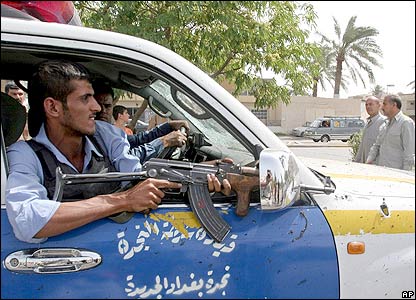
certainly the iraqi army and police don't have the armor and military equipment needed (see comments of their own generals, or picture, BBC, 14 May 2006). do contractors? the real problem continues to be the lack of oversight on contractors' activities, and the massive profits of the owners of contractors far away from the war itself.
  • Employees of defense contractors such as Halliburton, Blackwater and Wackenhut cook meals, do laundry, repair infrastructure, translate documents, analyze intelligence, guard prisoners, protect military convoys, deliver water in the heavily fortified Green Zone and stand sentry at buildings--often highly dangerous duties almost identical to those performed by many U.S. troops....
  • By the end of 2006, the Labor Department had quietly recorded 769 deaths and 3,367 injuries serious enough to require four or more days off the job. (“Iraq War Exacts Toll on Contractors,” by Michelle Roberts , AP, February 23, 2007 10:42 PM EST)


Tuesday, February 06, 2007

who you gonna call?
  • Paul Bremer told members of Congress today that he was aware that nonexistent "ghost employees" were on America's payroll when he was administrator of the Coalition Provisional Authority in Iraq in 2003 and 2004.
  • But because the real employees - who provided security for Iraqi ministries - were "74,000 armed men, it seemed a lesser risk to continue paying" everyone while trying to figure out who was actually showing up for work. (“Bremer Paid ‘Ghost Employees’ To Avoid ‘Real Trouble,’” by Melinda Henneberger, The Huffington Post, February 6, 2007)
so the us government pays iraq for private security, some of which is by us semi-private contractors (mercenaries) and some is by semi-private iraqis. and since some of it clearly didn't actually pay for security, that free-floating profit was, presumably, also paying for arms used against the us military.

update: at least someone on the hill sees how odd u.s. behavior was/is:
  • "Who in their right mind would send 363 tons of cash into a war zone?"

    Rep. Henry Waxman, chairman of the House Committee on Oversight and Government Reform, decrying the $4 billion the United States sent to Iraq to pay for goods after the invasion (US News & World Report, Washington Whispers)

Monday, February 05, 2007


supporting our troops?; or, supporting semi-private fiefdoms?
  • One of the reports released on Wednesday found that an American company, DynCorp, appeared to act almost independently of its contracting officers at the Department of State at times, billing the United States for millions of dollars of work that was never authorized and starting other jobs before they were requested.
  • The findings of misconduct against the company, on a $188 million job order to build living quarters and purchase weapons and equipment for the Iraqi police as part of a training program, were serious enough that the inspector general’s office began a fraud inquiry....
  • Stuart W. Bowen Jr., who is in charge of the office...declined to give further details but said that he was also initiating a countrywide review of DynCorp’s work in Iraq. The company has also received major contracts to train police in Afghanistan.
  • Gregory Lagana, a DynCorp spokesman, said the company would investigate the report’s findings. “We are looking into the issues raised by the inspector general with the goal of providing as full an accounting as possible,” Mr. Lagana said. “We believe we acted responsibly and with all due concern for the expenditure of public funds.” (”U.S. Agency Finds New Waste and Fraud in Iraqi Rebuilding Projects,” By James Glanz, New York Times, February 1, 2007)
of course the same contracting out is happening at home:
  • Under the guise of promoting a conservative agenda, the Bush administration has created a supersized version of the 19th-century spoils system. ("The Green-Zoning of America,"
    By Paul Krugman, New York Times, February 5, 2007)
as a contractor stated on the front page article in the sunday nyt, " "To us contractors..., money is always a good thing." (NYT, Feb. 4, 2007, p. 24) of course, it helps that it is the taxpayers' money. that way, nobody gets hurt.

Sunday, February 04, 2007

mercenaries make the man
  • The Defense Department plans to continue hiring private contractors to provide security at reconstruction projects in Iraq and to train U.S. and Iraqi military officers in counterinsurgency, despite problems with past contracts for such jobs that traditionally have been done by military personnel.
  • The contracting out of these wartime activities comes at a time when the United States is stretching its resources to provide the additional 21,500 troops in Iraq that are needed under President Bush's new strategy, which involves stepped-up counterinsurgency operations in Baghdad and the expansion of economic reconstruction activities.
  • During an appearance before the Senate Armed Services Committee last month, Army Lt. Gen. David H. Petraeus, the new top commander in Iraq, said he counts the "thousands of contract security forces" among the assets available to him to supplement the limited number of U.S. and Iraqi troops to be used for dealing with the insurgency.
  • A former senior Defense Intelligence Agency expert on the Middle East, retired Army Col. W. Patrick Lang, said last week that contracting out intelligence collection and security for Army units and their contractors "results from actual military forces being too small." He added: "I can't remember a subordinate commander considering mercenaries as part of his forces." (“Security Contracts to Continue in Iraq: New Top Commander Counts Hired Guards Among His Assets,” By Walter Pincus, Washington Post, Sunday, February 4, 2007; Page A19)
and it is not like we are actually getting good value for money spent on these blackwater types. it is just that they stay off the books, so to speak, and, thus, politically, or more expendable.

Saturday, January 27, 2007

blackwater's back

apologies for the longish excerpt:
  • Blackwater is back in the news, providing a reminder of just how privatized the war has become. On Tuesday, one of the company's helicopters was brought down in one of Baghdad's most violent areas. The men who were killed were providing diplomatic security under Blackwater's $300-million State Department contract, which dates to 2003 and the company's initial no-bid contract to guard administrator L. Paul Bremer III in Iraq....
  • Bush..., during his State of the Union speech, did address the very issue that has made the war's privatization a linchpin of his Iraq policy — the need for more troops. The president called on Congress to authorize an increase of...active-duty troops.... He then slipped in a mention of a major initiative that would represent a significant development in the U.S. disaster response/reconstruction/war machine: a Civilian Reserve Corps.
  • "Such a corps would function much like our military Reserve. It would ease the burden on the armed forces by allowing us to hire civilians with critical skills to serve on missions abroad when America needs them," Bush declared. This is precisely what the administration has already done, largely behind the backs of the American people and with little congressional input, with its revolution in military affairs. Bush and his political allies are using taxpayer dollars to run an outsourcing laboratory....
  • Already, private contractors constitute the second-largest "force" in Iraq. At last count, there were about 100,000 contractors in Iraq, of which 48,000 work as private soldiers, according to a Government Accountability Office report. These soldiers have operated with almost no oversight or effective legal constraints and are an undeclared expansion of the scope of the occupation. Many of these contractors make up to $1,000 a day, far more than active-duty soldiers. What's more...contractor deaths go uncounted in the official toll.
  • The president's proposed Civilian Reserve Corps was not his idea alone. A privatized version of it was floated two years ago by Erik Prince, the secretive, mega-millionaire, conservative owner of Blackwater USA and a man who for years has served as the Pied Piper of a campaign to repackage mercenaries as legitimate forces. In early 2005, Prince — a major bankroller of the president and his allies — pitched the idea at a military conference of a "contractor brigade" to supplement the official military. "There's consternation in the [Pentagon] about increasing the permanent size of the Army," Prince declared. Officials "want to add 30,000 people, and they talked about costs of anywhere from $3.6 billion to $4 billion to do that. Well, by my math, that comes out to about $135,000 per soldier." He added: "We could do it certainly cheaper." (“Our mercenaries in Iraq,” By Jeremy Scahill, January 25, 2007, Los Angeles Times)
a reminder: the film Iraq for Sale: The War Profiteers "tells the story of Erik Prince and Blackwater, and their consistent profiting from the war." (Robert Greenwald, 9, 25, 2006). The story of blackwater became big news in 2005 when the crisis in fallujah began a series of missteps by the u.s. army, in part to clean up the mess of prince and his semi-private business funded by your tax dollars (see “The Bridge, Chapter 4: A business gets a start,” by Joseph Neff and Jay Price, Staff Writers, Nov 28, 2005, News & Observer). if the new congress is going to have hearings on this war, perhaps they can start by supeonaing prince?

Thursday, January 11, 2007

a timely reminder about surges
  • What is striking about the current debate in Washington - whether to "surge" troops to Iraq and increase the size of the U.S. Army - is that roughly 100,000 bodies are missing from the equation: The number of American forces in Iraq is not 140,000, but more like 240,000.
  • What makes up the difference is the huge army of mercenaries - known these days as "private contractors." After the U.S. Army itself, they are easily the second-largest military force in the country. Yet no one seems sure of how many there are since they answer to no single authority. Indeed, the U.S. Central Command has only recently started taking a census of these battlefield civilians in an attempt to get a handle on the issue... (Barry Lando, Alternet - January 9, 2007)

Sunday, December 31, 2006

cost of doing business in iraq; or, coals to newcastle

lots of intriguing information regarding KBR fuel convoys:
  • A Halliburton subsidiary charged the Iraqi government as much as $25,000 per month for each of as many as 1,800 fuel trucks that were to deliver gasoline to Iraq after the 2003 invasion, but the trucks often spent days or weeks sitting idle on the border, says a report released yesterday by an auditing agency sponsored by the United Nations. (Cost of Taking Fuel to Iraq Is Questioned in New Audit, by James Glanz, November 7, 2006)
  • A federal judge in Texas yesterday threw out a lawsuit against Halliburton Co. that had been brought by survivors and the families of those killed when a fuel convoy was assaulted by insurgents outside Baghdad in April 2004. The suit had claimed Halliburton bore responsibility because the company knew the proposed route was the scene of a pitched battle but decided to send the drivers anyway. U.S. District Judge Gray H. Miller ruled that the Army had played a key role in sending the convoy and that it was not his place to second-guess that decision. "The contracts show that the Army, not the defendants, was responsible for the security of the convoys," he wrote. (Judge Dismisses Halliburton Suit, by Griff Witte, Washington Post Staff Writer, Saturday, September 23, 2006; Page D01)
what seems intriguing?: (1) we ship fuel from kuwait to iraq; (2) we pay kbr (nee Halliburton), which has a host of security contractors/mercenaries, and then they note that their security (read profit) is up to the us army, which, of course, has its own security concerns. good times, indeed.

Tuesday, November 21, 2006

and you might wonder what caci stands for...

California Analysis Center, Incorporated, actually [#921 in the 2006 Fortune 1000 list of the largest companies in America. CACI also ranked 8th among the top 10 information technology providers on the 2006 Fortune 500 list (from Wikipedia); its symbol: "Ever Vigilant"], although, to be near the trough, they are actually situated in arlington, va. you might remember them from the news a couple years back. well here they are again:
  • The story they [caci] don't want told is of a federal contractor that, according to the Washington Post, gets 92 percent of its revenues in the "defense" sector. The Washington Business Journal reported that CACI's defense contracts almost doubled in the year after the occupation of Iraq began, and profits shot up 52 percent.

  • Yet CACI insists it isn't a war profiteer (a subjective term anyway), but was just answering an urgent call in Iraq. In a letter to Greenwald, Koegel wrote: "the army needed ... civilian contractors to work as interrogators" because the military didn't have the personnel, and CACI responded to the "urgent war-time circumstances" and "has no apologies."

  • But while the firm had experience in electronic surveillance and other intelligence functions, it, too, didn't have the interrogators. Barry Lando reported finding an ad on CACI's website for interrogators to send to Iraq, and noted that "experience in conducting tactical and strategic interrogations" was desired, but not necessary. According to a report by the Army inspector general, 11 of the 31 CACI interrogators in Iraq had no training in what most experts agree is one of the most sensitive areas of intelligence gathering. The 205th Military Intelligence Brigade, which was in charge of interrogations at Abu Ghraib when the abuses took place, didn't have a single trained interrogator.

  • "It's insanity," former CIA agent Robert Baer told The Guardian. "These are rank amateurs, and there is no legally binding law on these guys as far as I could tell. Why did they let them in the prison?"("CACI: Torture in Iraq, Intimidation at Home," By Joshua Holland, AlterNet. Posted November 21, 2006)

it should be noted that caci maintains a "truth will out" page noting that
  • No CACI employee or former employee has ever been indicted for any misconduct in connection with CACI's work in Iraq. While three former employees have been cited in various reports in connection with disputed incidents in Iraq, no CACI employee took part or appears in any of the horrific photos released from Abu Ghraib.
indeed, in 2004, the caci's own legal team made the following points about the privatizing of military intelligence which has been the one-note samba of balkanization and this blog for some time:
  • We believe the following information adds perspective to CACI's work in Iraq.
  • The military did not have available interrogators needed to gather and analyze field source intelligence data and information in Iraq. CACI provides IT solutions and technology services to the U.S. Intelligence community. CACI interrogation services business is an extension of CACI's tactical intelligence and field services line of business for information collection, data analysis and decision support. CACI performs these contract services because of its commitment to its U.S. Army clients at war in the mid-East.
  • These private sector positions exist because the military downsized as part of a cutback plan in the early 1990's aimed at reducing Pentagon personnel while expanding technology and weapons. ("CACI's Letter to The Signal," Letter to the Editor, Dated Friday, June 11, 2004, Jody Brown, Senior Vice President, Public Relations, CACI International Inc., Arlington, VA)
privatize interrgators, the argument appears to be, so that you can have them on the cheap, experience not necessary, and then, when the war is over (when will the war on "terror" ever be over?) you can downsize quickly. not only does that mean weaker intelligence gathered, the potential for abuse done in the name of the citizens of the usa, and little or no oversight, it clearly is saving the usa taxpayer no money as this group has not been downsized in the least (see caci profits above).

Tuesday, November 14, 2006

before we leave....

might we have a bit of oversight, a review, an inquiry even, into the role of private companies on the public spiggot?
  • As Bechtel Corp. exits Iraq, we still know little about the quality of the company's work there.
    Government reports on Bechtel's Iraq projects often discuss ballooning costs and blown schedules, blaming the costs and delays on security problems. For the most part, you won't see how well the San Francisco engineering company repaired the power and sewage plants under its care or how wisely it spent the $2.3 billion in its contracts.

  • The same holds true for many of the other engineering and construction companies that have spent the past three years rebuilding Iraq. Some, including Halliburton and Parsons Corp., have seen their projects scrutinized in depth. Others haven't. (Little scrutiny for firms in Iraq, S.F.'s Bechtel among most prominent ones, David R. Baker, San Francisco Chronicle Staff Writer, Tuesday, November 14, 2006)

Saturday, October 07, 2006

i guess one does not need to worry about the privatization of this war

the war is grim (and not a money-maker, unless the u.s. government agrees to keep funding these private security firms--hey, where are their security forces?; do they venture outside the green zone?):
  • Last month, 776 U.S. troops were wounded in action in Iraq, the highest number since the military assault to retake the insurgent-held city of Fallujah in November 2004, according to Defense Department data. It was the fourth-highest monthly total since the U.S.-led invasion of Iraq in March 2003.

and what all this carnage buys us is just a little, a very little, time:

Sunday, September 24, 2006

holding out for a hero

we'll save the middle east by saving iraq. we'll save iraq by saving baghdad. anyone for holding on to the green zone?
  • General John Abizaid, the head of US Central Command, became the first top official to openly use the "CW" words last month when he told the Senate: "I believe that the sectarian violence is probably as bad as I've seen it in Baghdad in particular, and that if not stopped it is possible that Iraq could move toward civil war."...
  • The death toll makes it harder and harder for Bush to ask: do you really think Iraq would have been better off under Saddam Hussein? But as the body count climbs with every month, the question loses its power. If things really fall apart and the Baghdad government cannot hold, the only honest answer will be: yes, Iraqis would have been better off left alone. (Tiptoeing round Iraq's verbal minefield / Washington diary / Julian Borger, Guardian Weekly, 10 Sept. 2006)