Saturday, February 24, 2007

not hessians exactly

they are paid well, but do they have the armor and tools for the job? contractors' relatives don't think so:
  • A day before four of the company's security guards died in Iraq, a Blackwater USA employee wrote company officials that it was time to stop the "smoke and mirror show" and provide crucial equipment for the private army in the field.
  • "I need Comms (communications equipment). ... I need ammo. ... I need Glocks and M4s. ... Guys are in the field with borrowed stuff and in harm's way," said the e-mail, released at a House hearing Wednesday.
  • Blackwater employee Tom Powell wrote the memo to other company officials on March 30, 2004.
  • The next day, a mob in Fallujah ambushed a supply convoy guarded by Blackwater, killing the four employees who all were former members of the military. ("Slain Iraq contractors short on armor, families say,"
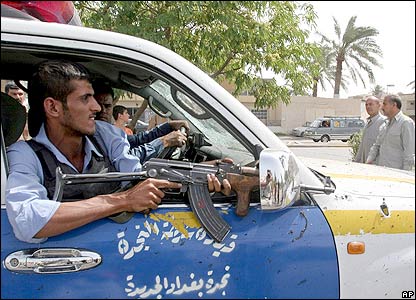
certainly the iraqi army and police don't have the armor and military equipment needed (see comments of their own generals, or picture, BBC, 14 May 2006). do contractors? the real problem continues to be the lack of oversight on contractors' activities, and the massive profits of the owners of contractors far away from the war itself.
  • Employees of defense contractors such as Halliburton, Blackwater and Wackenhut cook meals, do laundry, repair infrastructure, translate documents, analyze intelligence, guard prisoners, protect military convoys, deliver water in the heavily fortified Green Zone and stand sentry at buildings--often highly dangerous duties almost identical to those performed by many U.S. troops....
  • By the end of 2006, the Labor Department had quietly recorded 769 deaths and 3,367 injuries serious enough to require four or more days off the job. (“Iraq War Exacts Toll on Contractors,” by Michelle Roberts , AP, February 23, 2007 10:42 PM EST)


Tuesday, February 06, 2007

who you gonna call?
  • Paul Bremer told members of Congress today that he was aware that nonexistent "ghost employees" were on America's payroll when he was administrator of the Coalition Provisional Authority in Iraq in 2003 and 2004.
  • But because the real employees - who provided security for Iraqi ministries - were "74,000 armed men, it seemed a lesser risk to continue paying" everyone while trying to figure out who was actually showing up for work. (“Bremer Paid ‘Ghost Employees’ To Avoid ‘Real Trouble,’” by Melinda Henneberger, The Huffington Post, February 6, 2007)
so the us government pays iraq for private security, some of which is by us semi-private contractors (mercenaries) and some is by semi-private iraqis. and since some of it clearly didn't actually pay for security, that free-floating profit was, presumably, also paying for arms used against the us military.

update: at least someone on the hill sees how odd u.s. behavior was/is:
  • "Who in their right mind would send 363 tons of cash into a war zone?"

    Rep. Henry Waxman, chairman of the House Committee on Oversight and Government Reform, decrying the $4 billion the United States sent to Iraq to pay for goods after the invasion (US News & World Report, Washington Whispers)

Monday, February 05, 2007


supporting our troops?; or, supporting semi-private fiefdoms?
  • One of the reports released on Wednesday found that an American company, DynCorp, appeared to act almost independently of its contracting officers at the Department of State at times, billing the United States for millions of dollars of work that was never authorized and starting other jobs before they were requested.
  • The findings of misconduct against the company, on a $188 million job order to build living quarters and purchase weapons and equipment for the Iraqi police as part of a training program, were serious enough that the inspector general’s office began a fraud inquiry....
  • Stuart W. Bowen Jr., who is in charge of the office...declined to give further details but said that he was also initiating a countrywide review of DynCorp’s work in Iraq. The company has also received major contracts to train police in Afghanistan.
  • Gregory Lagana, a DynCorp spokesman, said the company would investigate the report’s findings. “We are looking into the issues raised by the inspector general with the goal of providing as full an accounting as possible,” Mr. Lagana said. “We believe we acted responsibly and with all due concern for the expenditure of public funds.” (”U.S. Agency Finds New Waste and Fraud in Iraqi Rebuilding Projects,” By James Glanz, New York Times, February 1, 2007)
of course the same contracting out is happening at home:
  • Under the guise of promoting a conservative agenda, the Bush administration has created a supersized version of the 19th-century spoils system. ("The Green-Zoning of America,"
    By Paul Krugman, New York Times, February 5, 2007)
as a contractor stated on the front page article in the sunday nyt, " "To us contractors..., money is always a good thing." (NYT, Feb. 4, 2007, p. 24) of course, it helps that it is the taxpayers' money. that way, nobody gets hurt.

Sunday, February 04, 2007

mercenaries make the man
  • The Defense Department plans to continue hiring private contractors to provide security at reconstruction projects in Iraq and to train U.S. and Iraqi military officers in counterinsurgency, despite problems with past contracts for such jobs that traditionally have been done by military personnel.
  • The contracting out of these wartime activities comes at a time when the United States is stretching its resources to provide the additional 21,500 troops in Iraq that are needed under President Bush's new strategy, which involves stepped-up counterinsurgency operations in Baghdad and the expansion of economic reconstruction activities.
  • During an appearance before the Senate Armed Services Committee last month, Army Lt. Gen. David H. Petraeus, the new top commander in Iraq, said he counts the "thousands of contract security forces" among the assets available to him to supplement the limited number of U.S. and Iraqi troops to be used for dealing with the insurgency.
  • A former senior Defense Intelligence Agency expert on the Middle East, retired Army Col. W. Patrick Lang, said last week that contracting out intelligence collection and security for Army units and their contractors "results from actual military forces being too small." He added: "I can't remember a subordinate commander considering mercenaries as part of his forces." (“Security Contracts to Continue in Iraq: New Top Commander Counts Hired Guards Among His Assets,” By Walter Pincus, Washington Post, Sunday, February 4, 2007; Page A19)
and it is not like we are actually getting good value for money spent on these blackwater types. it is just that they stay off the books, so to speak, and, thus, politically, or more expendable.

Saturday, January 27, 2007

blackwater's back

apologies for the longish excerpt:
  • Blackwater is back in the news, providing a reminder of just how privatized the war has become. On Tuesday, one of the company's helicopters was brought down in one of Baghdad's most violent areas. The men who were killed were providing diplomatic security under Blackwater's $300-million State Department contract, which dates to 2003 and the company's initial no-bid contract to guard administrator L. Paul Bremer III in Iraq....
  • Bush..., during his State of the Union speech, did address the very issue that has made the war's privatization a linchpin of his Iraq policy — the need for more troops. The president called on Congress to authorize an increase of...active-duty troops.... He then slipped in a mention of a major initiative that would represent a significant development in the U.S. disaster response/reconstruction/war machine: a Civilian Reserve Corps.
  • "Such a corps would function much like our military Reserve. It would ease the burden on the armed forces by allowing us to hire civilians with critical skills to serve on missions abroad when America needs them," Bush declared. This is precisely what the administration has already done, largely behind the backs of the American people and with little congressional input, with its revolution in military affairs. Bush and his political allies are using taxpayer dollars to run an outsourcing laboratory....
  • Already, private contractors constitute the second-largest "force" in Iraq. At last count, there were about 100,000 contractors in Iraq, of which 48,000 work as private soldiers, according to a Government Accountability Office report. These soldiers have operated with almost no oversight or effective legal constraints and are an undeclared expansion of the scope of the occupation. Many of these contractors make up to $1,000 a day, far more than active-duty soldiers. What's more...contractor deaths go uncounted in the official toll.
  • The president's proposed Civilian Reserve Corps was not his idea alone. A privatized version of it was floated two years ago by Erik Prince, the secretive, mega-millionaire, conservative owner of Blackwater USA and a man who for years has served as the Pied Piper of a campaign to repackage mercenaries as legitimate forces. In early 2005, Prince — a major bankroller of the president and his allies — pitched the idea at a military conference of a "contractor brigade" to supplement the official military. "There's consternation in the [Pentagon] about increasing the permanent size of the Army," Prince declared. Officials "want to add 30,000 people, and they talked about costs of anywhere from $3.6 billion to $4 billion to do that. Well, by my math, that comes out to about $135,000 per soldier." He added: "We could do it certainly cheaper." (“Our mercenaries in Iraq,” By Jeremy Scahill, January 25, 2007, Los Angeles Times)
a reminder: the film Iraq for Sale: The War Profiteers "tells the story of Erik Prince and Blackwater, and their consistent profiting from the war." (Robert Greenwald, 9, 25, 2006). The story of blackwater became big news in 2005 when the crisis in fallujah began a series of missteps by the u.s. army, in part to clean up the mess of prince and his semi-private business funded by your tax dollars (see “The Bridge, Chapter 4: A business gets a start,” by Joseph Neff and Jay Price, Staff Writers, Nov 28, 2005, News & Observer). if the new congress is going to have hearings on this war, perhaps they can start by supeonaing prince?

Thursday, January 11, 2007

a timely reminder about surges
  • What is striking about the current debate in Washington - whether to "surge" troops to Iraq and increase the size of the U.S. Army - is that roughly 100,000 bodies are missing from the equation: The number of American forces in Iraq is not 140,000, but more like 240,000.
  • What makes up the difference is the huge army of mercenaries - known these days as "private contractors." After the U.S. Army itself, they are easily the second-largest military force in the country. Yet no one seems sure of how many there are since they answer to no single authority. Indeed, the U.S. Central Command has only recently started taking a census of these battlefield civilians in an attempt to get a handle on the issue... (Barry Lando, Alternet - January 9, 2007)

Sunday, December 31, 2006

cost of doing business in iraq; or, coals to newcastle

lots of intriguing information regarding KBR fuel convoys:
  • A Halliburton subsidiary charged the Iraqi government as much as $25,000 per month for each of as many as 1,800 fuel trucks that were to deliver gasoline to Iraq after the 2003 invasion, but the trucks often spent days or weeks sitting idle on the border, says a report released yesterday by an auditing agency sponsored by the United Nations. (Cost of Taking Fuel to Iraq Is Questioned in New Audit, by James Glanz, November 7, 2006)
  • A federal judge in Texas yesterday threw out a lawsuit against Halliburton Co. that had been brought by survivors and the families of those killed when a fuel convoy was assaulted by insurgents outside Baghdad in April 2004. The suit had claimed Halliburton bore responsibility because the company knew the proposed route was the scene of a pitched battle but decided to send the drivers anyway. U.S. District Judge Gray H. Miller ruled that the Army had played a key role in sending the convoy and that it was not his place to second-guess that decision. "The contracts show that the Army, not the defendants, was responsible for the security of the convoys," he wrote. (Judge Dismisses Halliburton Suit, by Griff Witte, Washington Post Staff Writer, Saturday, September 23, 2006; Page D01)
what seems intriguing?: (1) we ship fuel from kuwait to iraq; (2) we pay kbr (nee Halliburton), which has a host of security contractors/mercenaries, and then they note that their security (read profit) is up to the us army, which, of course, has its own security concerns. good times, indeed.

Tuesday, November 21, 2006

and you might wonder what caci stands for...

California Analysis Center, Incorporated, actually [#921 in the 2006 Fortune 1000 list of the largest companies in America. CACI also ranked 8th among the top 10 information technology providers on the 2006 Fortune 500 list (from Wikipedia); its symbol: "Ever Vigilant"], although, to be near the trough, they are actually situated in arlington, va. you might remember them from the news a couple years back. well here they are again:
  • The story they [caci] don't want told is of a federal contractor that, according to the Washington Post, gets 92 percent of its revenues in the "defense" sector. The Washington Business Journal reported that CACI's defense contracts almost doubled in the year after the occupation of Iraq began, and profits shot up 52 percent.

  • Yet CACI insists it isn't a war profiteer (a subjective term anyway), but was just answering an urgent call in Iraq. In a letter to Greenwald, Koegel wrote: "the army needed ... civilian contractors to work as interrogators" because the military didn't have the personnel, and CACI responded to the "urgent war-time circumstances" and "has no apologies."

  • But while the firm had experience in electronic surveillance and other intelligence functions, it, too, didn't have the interrogators. Barry Lando reported finding an ad on CACI's website for interrogators to send to Iraq, and noted that "experience in conducting tactical and strategic interrogations" was desired, but not necessary. According to a report by the Army inspector general, 11 of the 31 CACI interrogators in Iraq had no training in what most experts agree is one of the most sensitive areas of intelligence gathering. The 205th Military Intelligence Brigade, which was in charge of interrogations at Abu Ghraib when the abuses took place, didn't have a single trained interrogator.

  • "It's insanity," former CIA agent Robert Baer told The Guardian. "These are rank amateurs, and there is no legally binding law on these guys as far as I could tell. Why did they let them in the prison?"("CACI: Torture in Iraq, Intimidation at Home," By Joshua Holland, AlterNet. Posted November 21, 2006)

it should be noted that caci maintains a "truth will out" page noting that
  • No CACI employee or former employee has ever been indicted for any misconduct in connection with CACI's work in Iraq. While three former employees have been cited in various reports in connection with disputed incidents in Iraq, no CACI employee took part or appears in any of the horrific photos released from Abu Ghraib.
indeed, in 2004, the caci's own legal team made the following points about the privatizing of military intelligence which has been the one-note samba of balkanization and this blog for some time:
  • We believe the following information adds perspective to CACI's work in Iraq.
  • The military did not have available interrogators needed to gather and analyze field source intelligence data and information in Iraq. CACI provides IT solutions and technology services to the U.S. Intelligence community. CACI interrogation services business is an extension of CACI's tactical intelligence and field services line of business for information collection, data analysis and decision support. CACI performs these contract services because of its commitment to its U.S. Army clients at war in the mid-East.
  • These private sector positions exist because the military downsized as part of a cutback plan in the early 1990's aimed at reducing Pentagon personnel while expanding technology and weapons. ("CACI's Letter to The Signal," Letter to the Editor, Dated Friday, June 11, 2004, Jody Brown, Senior Vice President, Public Relations, CACI International Inc., Arlington, VA)
privatize interrgators, the argument appears to be, so that you can have them on the cheap, experience not necessary, and then, when the war is over (when will the war on "terror" ever be over?) you can downsize quickly. not only does that mean weaker intelligence gathered, the potential for abuse done in the name of the citizens of the usa, and little or no oversight, it clearly is saving the usa taxpayer no money as this group has not been downsized in the least (see caci profits above).

Tuesday, November 14, 2006

before we leave....

might we have a bit of oversight, a review, an inquiry even, into the role of private companies on the public spiggot?
  • As Bechtel Corp. exits Iraq, we still know little about the quality of the company's work there.
    Government reports on Bechtel's Iraq projects often discuss ballooning costs and blown schedules, blaming the costs and delays on security problems. For the most part, you won't see how well the San Francisco engineering company repaired the power and sewage plants under its care or how wisely it spent the $2.3 billion in its contracts.

  • The same holds true for many of the other engineering and construction companies that have spent the past three years rebuilding Iraq. Some, including Halliburton and Parsons Corp., have seen their projects scrutinized in depth. Others haven't. (Little scrutiny for firms in Iraq, S.F.'s Bechtel among most prominent ones, David R. Baker, San Francisco Chronicle Staff Writer, Tuesday, November 14, 2006)

Saturday, October 07, 2006

i guess one does not need to worry about the privatization of this war

the war is grim (and not a money-maker, unless the u.s. government agrees to keep funding these private security firms--hey, where are their security forces?; do they venture outside the green zone?):
  • Last month, 776 U.S. troops were wounded in action in Iraq, the highest number since the military assault to retake the insurgent-held city of Fallujah in November 2004, according to Defense Department data. It was the fourth-highest monthly total since the U.S.-led invasion of Iraq in March 2003.

and what all this carnage buys us is just a little, a very little, time:

Sunday, September 24, 2006

holding out for a hero

we'll save the middle east by saving iraq. we'll save iraq by saving baghdad. anyone for holding on to the green zone?
  • General John Abizaid, the head of US Central Command, became the first top official to openly use the "CW" words last month when he told the Senate: "I believe that the sectarian violence is probably as bad as I've seen it in Baghdad in particular, and that if not stopped it is possible that Iraq could move toward civil war."...
  • The death toll makes it harder and harder for Bush to ask: do you really think Iraq would have been better off under Saddam Hussein? But as the body count climbs with every month, the question loses its power. If things really fall apart and the Baghdad government cannot hold, the only honest answer will be: yes, Iraqis would have been better off left alone. (Tiptoeing round Iraq's verbal minefield / Washington diary / Julian Borger, Guardian Weekly, 10 Sept. 2006)

Thursday, August 31, 2006

pop quiz

the president of the u.s.a. recently made the following speech:
  • "If America were to pull out before Iraq could defend itself, the consequences would be absolutely predictable, and absolutely disastrous. We would be handing Iraq over to our worst enemies -- Saddam's former henchmen, armed groups with ties to Iran, and al-Qaida terrorists from all over the world who would suddenly have a base of operations far more valuable than Afghanistan under the Taliban."
who are the allies of u.s.a. in iraq? is it: (a) Saddam's former henchmen, (b) armed groups with ties to Iran, or (c) al-Qaida terrorists from all over the world?

answer: (b) those are important to shore up support for prime minister mr. al-maliki, and a bit of (a). indeed, it is not a bad idea to have some connections with and even alliance with these two groups. they represent a good chunk of the iraqi people (not the kurds, of course, but then we have pretty much forgotten them). but here is the rub: if our government doesn't begin to separate out al-qaida leaders from al-qaida sympathizers (a sizable group), and al-qaida from home-grown leaders (try politicians not henchmen), we will never be any closer to "handing over" anything to anybody.
"If America were to pull out...the consequences would be...absolutely disastrous"

the header is from president george bush in an article that focuses on a series of bombings and other killings in baghdad (last gasp of terrorists of course) and the rest of iraq.

i suppose it is too small a point to point out that the consequences of staying in are absolutely disastrous now?

Tuesday, August 01, 2006

"prepare to take back"!?; "prepare to take"!?: who the hell writes this stuff?

i should be writing about custer battles and roy trumble, but it is too difficult to figure out who is sleasiest, so i will just attack our journalists instead.
how long have usa troops been in iraq? they are just now preparing to take back baghdad's streets? give me a break. why not let rumsfeld just write the ap articles?

Saturday, July 29, 2006

victory over drug lords still in distant future
  • NATO will embark on the biggest mission in its history on Monday when it takes over security from the U.S.-led coalition in six southern provinces [of southern afghanistan], extending its authority to almost all of the country.
  • British Lieutenant-General David Richards said he hoped to see improvements in the south within three to six months, which would allow the 26-nation alliance to proceed with the final phase of its deployment into the east by the end of the year.
  • Afghanistan is going through the bloodiest phase of violence since the fall of the Taliban government in 2001, with most attacks occurring in the south.
  • Richards told a news conference in Kabul that the violence was inextricably linked to drugs.
  • "Essentially for the last four years some very brutal people have been developing their little fiefdoms down there and exporting a lot of opium to the rest of the world," he said.
  • "That very evil trade is being threatened by the NATO expansion in the south. This is a very noble cause we're engaged in and we have to liberate the people from that scourge of those warlords." (NATO sets sights on Afghan drug barons, By Jeremy Laurence, July 29, 2006, KABUL, Reuters)
good news, indeed, but has anyone doubted the link between taliban in southern afghanistan (or hezbollah and bakaa valley) and drug trafficking? is there any reason we are only now turning to this issue? or that it is not the usa, nor "coalition" troops, but nato that is taking on this issue? couldn't be that we wasted time, money, good will, and troop and civilian casualties in iraq could it? but smuggling, of any sort, works best when it works with the existing government (helps eliminate your competitors, and, without high duties or barriers to trade, the smuggler wouldn't have a profit motive). look to see this latest nato-led move corrupted in, well, 3-to-6 months. there is too much money to be made in an area with too little money.

Friday, July 28, 2006

never, ever again do i want to hear about the inefficiency of the united nations or public, government projects: private business can't get it up
  • The United States is dropping Bechtel, the American construction giant, from a project to build a high-tech children’s hospital in the southern Iraqi city of Basra after the project fell nearly a year behind schedule and exceeded its expected cost by as much as 150 percent.
  • Called the Basra Children’s Hospital, the project has been consistently championed by the first lady, Laura Bush, and Secretary of State Condoleezza Rice, and was designed to house sophisticated equipment for treating childhood cancer.
  • Now it becomes the latest in a series of American taxpayer-financed health projects in Iraq to face overruns, delays and cancellations. Earlier this year, the Army Corps of Engineers canceled more than $300 million in contracts held by Parsons, another American contractor, to build and refurbish hospitals and clinics across Iraq.
  • American and Iraqi government officials described the move to drop Bechtel in interviews on Thursday, and Ammar al-Saffar, a deputy health minister in Baghdad, allowed a reporter to take notes on briefing papers on the subject he said he had recently been given by the State Department.
  • The United States will “disengage Bechtel and transfer program and project management” to the Army Corps of Engineers, the papers say. Bechtel, the State Department agency in charge of the work and the Health Department in Basra all confirmed that the company would be leaving the project, but the reasons are a matter of deep disagreement.
  • The Iraqis assert that management blunders by the company have caused the project to teeter on the verge of collapse; the American government says Bechtel did the best it could as it faced everything from worsening security to difficult soil conditions.
  • A senior company official said Thursday that for its part Bechtel recommended that the work be mothballed and in essence volunteered to leave the project because the security problems had become intolerable. He also disputed the American government’s calculation of cost overruns, saying that accounting rules had recently been changed in a way that inflated the figures.
  • The official, Cliff Mumm, who is president of the Bechtel infrastructure division, predicted that the project would fail if the government pressed ahead, as the briefing papers indicate that it would. Because of the rise of sectarian militias in southern Iraq, Mr. Mumm said, “it is not a good use of the government’s money” to try to finish the project.
  • “And we do not think it can be finished,” he said. (Series of Woes Mar Iraq Project Hailed as Model, By JAMES GLANZ, Published: July 28, 2006, BAGHDAD, Iraq, July 2)
i take that back: it was my tax dollars and yours that funded this disaster; i guess we cannot blame private corporations--they just took the profits and ran.

Thursday, July 27, 2006

controlling iraq is the key to controlling the middle east; controlling baghdad is the key to controlling iraq; controlling the green zone is the key to controlling the red zone: is this the direction the neo-cons suggested we would be moving?

time for some optimism from operation iraqi freedom, the official website of multinational force--iraq:
whoo-hooh! woo-hah! how many more decisive periods can iraq take? how many more shifts in policy can we take? fallujah was to control sunni; baghdad is to control shi'ite; and kurds aren't really playing ball with either.

but never mind me; how do american troops feel about being part of a "decisive period" in this area of emergent business services?
  • Army Staff Sgt. Jose Sixtos considered the simple question about morale for more than an hour....
  • "Think of what you hate most about your job. Then think of doing what you hate most for five straight hours, every single day, sometimes twice a day, in 120-degree heat," he said. "Then ask how morale is."
  • Frustrated? "You have no idea," he said....
  • "It sucks. Honestly, it just feels like we're driving around waiting to get blown up. That's the most honest answer I could give you," said Spec. Tim Ivey, 28, of San Antonio, a muscular former backup fullback for Baylor University. "You lose a couple friends and it gets hard."
  • "No one wants to be here, you know, no one is truly enthused about what we do," said Sgt. Christopher Dugger, the squad leader. ('Waiting to Get Blown Up', Some Troops in Baghdad Express Frustration With the War and Their Mission, By Joshua Partlow Washington Post Staff Writer, Thursday, July 27, 2006)
but at least the folks that sent them over there, those that see the big picture, are still optimistic, yes?
  • Faced with almost daily reports of sectarian carnage in Iraq, congressional Republicans are shifting their message on the war from speaking optimistically of progress to acknowledging the difficulty of the mission and pointing up mistakes in planning and execution.
  • Rep. Christopher Shays (Conn.) is using his House Government Reform subcommittee on national security to vent criticism of the White House's war strategy and new estimates of the monetary cost of the war. Rep. Gil Gutknecht (Minn.), once a strong supporter of the war, returned from Iraq this week declaring that conditions in Baghdad were far worse "than we'd been led to believe" and urging that troop withdrawals begin immediately. (GOP Lawmakers Edge Away From Optimism on Iraq By Jonathan Weisman and Anushka Asthana Washington Post Staff Writers Thursday, July 20, 2006)
perhaps we ought to begin considering what iraqis think and think of some new options.

Sunday, July 23, 2006

and the privatization answer to this balkanization in iraq is...?

i don't think we can do much more than note the reporting at this point.
  • Iraqi leaders have all but given up on holding the country together and, just two months after forming a national unity government, talk in private of "black days" of civil war ahead.
  • Signalling a dramatic abandonment of the U.S.-backed project for Iraq, there is even talk among them of pre-empting the worst bloodshed by agreeing to an east-west division of Baghdad into Shi'ite and Sunni Muslim zones, senior officials told Reuters.
  • Tens of thousands have already fled homes on either side.
  • "Iraq as a political project is finished," one senior government official said -- anonymously because the coalition under Prime Minister Nuri al-Maliki remains committed in public to the U.S.-sponsored constitution that preserves Iraq's unity....
  • "The parties have moved to Plan B," the senior official said, saying Sunni, ethnic Kurdish and majority Shi'ite blocs were looking at ways to divide power and resources and to solve the conundrum of Baghdad's mixed population of seven million.
  • "There is serious talk of Baghdad being divided into east and west," he said. "We are extremely worried."
  • On the eve of the first meeting of a National Reconciliation Commission and before Maliki meets President George W. Bush in Washington next week, other senior politicians also said they were close to giving up on hopes of preserving the 80-year-old, multi-ethnic, religiously mixed state in its present form.
  • "The situation is terrifying and black," said Rida Jawad al -Takki, a senior member of parliament from Maliki's dominant Shi'ite Alliance bloc, and one of the few officials from all the main factions willing to speak publicly on the issue.
  • "We have received information of a plan to divide Baghdad. The government is incapable of solving the situation," he said. (By Mariam Karouny, BAGHDAD, July 21, Reuters)

Saturday, July 22, 2006

pmcs will save the world (not)

i'd like to know more about which pmcs the general had in mind, but, folks, we have a problem here:
  • The most senior British military commander in Afghanistan yesterday described the situation in the country as "close to anarchy" with feuding foreign agencies and unethical private security companies compounding problems caused by local corruption.
  • The stark warning came from Lieutenant General David Richards, head of Nato's international security force in Afghanistan, who warned that western forces there were short of equipment and were "running out of time" if they were going to meet the expectations of the Afghan people....
  • He described "poorly regulated private security companies" as unethical and "all too ready to discharge firearms"....
  • Afghanistan is now one of the poorest countries with an economy and infrastructure in ruins. (Richard Norton-Taylor, Saturday July 22, 2006, The Guardian)
of course, it has long been known that karzai holds sway over just a small area around kabul and the warlords and their armies hold the rest:
but the general's wording suggests that it is not warlord militias but private sector, western-style, pmcs that are proving to be a greater and greater impediment to peace and reconstruction. let's see: we didn't do afghanistan right so we decided to go fix iraq; that policy is now in tatters (time for the pmcs!), so it looks like it is on to iran; but wait, maybe we'll fix lebanon first....

Friday, July 21, 2006

bomb 'em all: and other points made by very small minds

two small quotes that indicate, for all the tentativeness of the leadership of the democratic party of the usa, it is light years ahead of republican thinking on world affairs. The first is from newt gingrich, who, besides giving my name a bad name, is a former everything.
  • Gingrich says America is in World War III and President Bush should say so....
  • He lists wars in Afghanistan, Iraq, this week's bomb attacks in India, North Korean nuclear threats, terrorist arrests and investigations in Florida, Canada and Britain, and violence in Israel and Lebanon as evidence of World War III. He said Bush needs to deliver a speech to Congress and "connect all the dots" for Americans....
  • "This is World War III," Gingrich said. And once that's accepted, he said calls for restraint would fall away. (Seattle Times, July 15, 2006, Posted by David Postman)
uhhh..., ok. so it turns out he is right and there are enemies in florida, canada, britain, india, etc. we bomb them? we go out on scrap drives so we can build ships to go, uhhh....where? it turns out we are not at war with another country (though israel appears to be veering closer to that); we cannot just bomb them. terrorist groups exist. but they don't hold territory, etc. if they do, they soon cease to be terrorists. that was/is the problem of hezbollah's leadership: they were settling down to rule southern lebanon, and then hamas stole their thunder, and, most probably, the young turks (small joke there) among hezbollah got bolshie.

but we can't attack sovereign nations just because they have criminals amongst them. and we can't keep operating as if it is a manichean world with no grey area. and we have to stop operating as if all terrorists are connected to some bond-like s.p.e.c.t.r.e. which was my other quote.
  • Bush: You see, the ... thing is what they need to do is to get Syria, to get Hezbollah to stop doing this shit and it's over.
i doubt that syria controls hezbollah at this point. i doubt that hezbollah (old leaders) controls hezbollah (young turks) at this point. syria needs to be involved (wouldn't the usa rather have syria than a fundamentalist islamic state there?); iran needs to be involved. but to ignore that there is no united "arc of evil" is to be self-deceived. and, given the reports from iraq and afghanistan these days, is whistling past the graveyard.